Technology & Products
How Current is Created in Smartphones? The Working Principles of Lithium-ion Batteries
2026.08.18
|
□ Lithium ions move inside the battery, and electrons move along the circuit connecting the battery to the device □ The movement of electrons generates current and powers the smartphone □ The electrolyte and separator let lithium ions move while blocking electrons, ensuring safe battery operation |
Lithium-ion batteries provide energy to various devices including smartphones, EVs, and ESS. What is the principle behind how batteries generate electric energy? The secret lies in the movement of lithium ions and electrons.
Current flows due to the movement of lithium ions and electrons
Imagine you charge a smartphone. When you connect a charger to it, energy comes from an external source, which makes lithium ions and electrons travel from cathode to anode within the battery. Conversely, when using smartphones, lithium ions and electrons stored in the anode during charging move to the cathode.
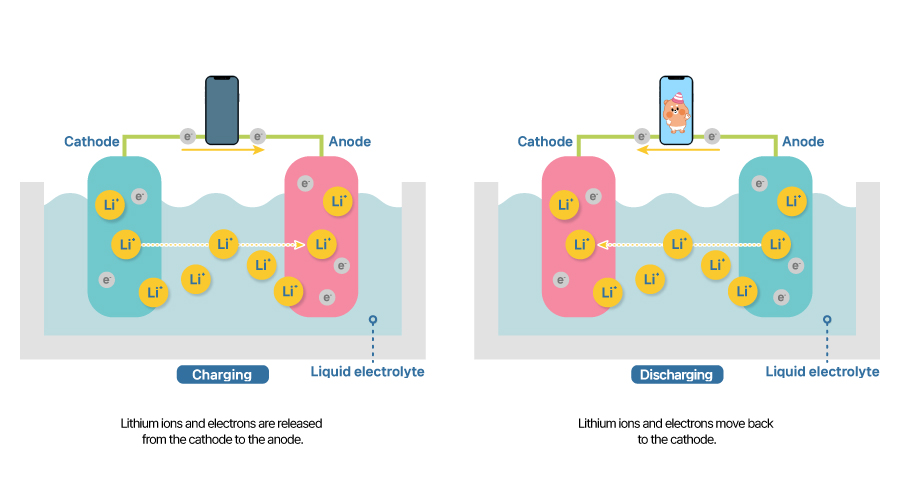
[The principles of charging and discharging lithium ion batteries]
At this point, lithium ions travel through the electrolyte in the battery, and electrons go through a circuit connected to the smartphone. The movement of electrons enables the flow of electric current, which allows us to connect with friends or access multimedia content with our smartphones.
The electrolyte and separator guide lithium ions and electrons along the right path
What if electrons could pass through the battery’s interior? In this situation, devices connected to the battery would not receive sufficient power, and the battery’s performance and safety could be adversely affected, for example, by internal heat. This is why batteries are built with mechanisms to prevent such issues.
Key components include the electrolyte and separator located between the anode and cathode. The electrolyte is engineered to allow lithium ions to pass through while blocking electrons. Consequently, electrons flow along the circuit connected to devices such as smartphones.
Learn more about electrolytes: [SDI Focus] Electrolytes: Facilitator for Li-Ion Transfer
The separator prevents direct contact between the anode and cathode, as direct contact could cause safety issues. Yet, the separator has a structure with microscopic pores that allows lithium ions to move within the cell.
Learn more about separators: [Battery Talk Talk] How Can Lithium-Ions Pass Separator?
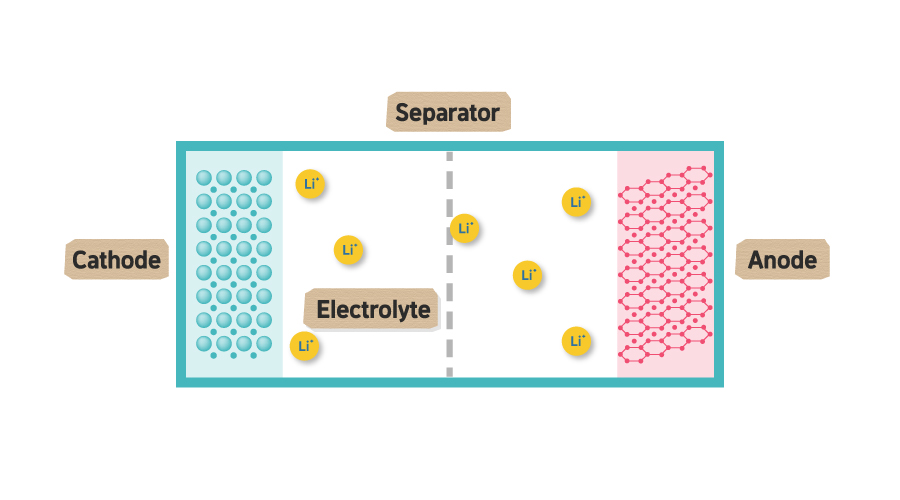
[Electrolyte and separator in lithium ion batteries]
Inside the battery, lithium ions and electrons each perform their own roles. Behind the electricity we use every day, there’s a system of teamwork between lithium ions and electrons, running along different paths yet working together.

SAMSUNG SDI Newsroom
We deliver the latest news and issues coming out of SAMSUNG SDI.