Technology & Products
[Battery Talk Talk] How Can Lithium-Ions Pass Separator?
2026.01.27
|
[Battery Talk Talk] From simple curiosities to insight-driven questions, let’s walk through “all about battery” briefly. |
In lithium-ion battery, lithium ions move between cathode and anode, which enables charging and discharging. Between the cathode and anode, a separator acts as a protective membrane to prevent direct contact. How can lithium ions pass this “membrane?”
You need to look at the basic structure of the battery to understand this principle.
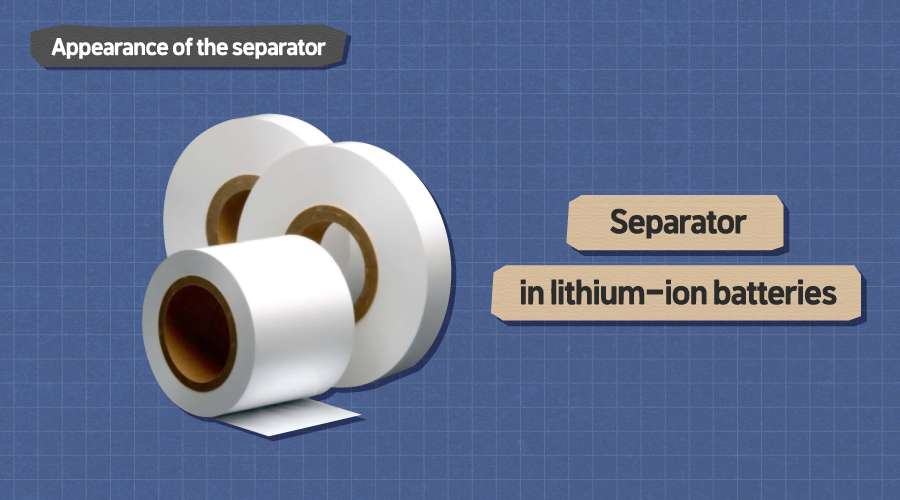
[How can lithium-ions pass the separator that seems to have no small gaps?]
Lithium-ion batteries consist of a cathode, anode, electrolyte, and separator. During charging, lithium ions move from the cathode to the anode, storing energy. During discharging, they flow back to the cathode, releasing energy.
In this process, the electrolyte allows the lithium ions to move between the anode and cathode. The separator prevents direct contact between the anode and cathode while also providing fine pathways for lithium ions to travel.
The reason lithium ions can move freely within the cell is due to the unique structure of the separator.
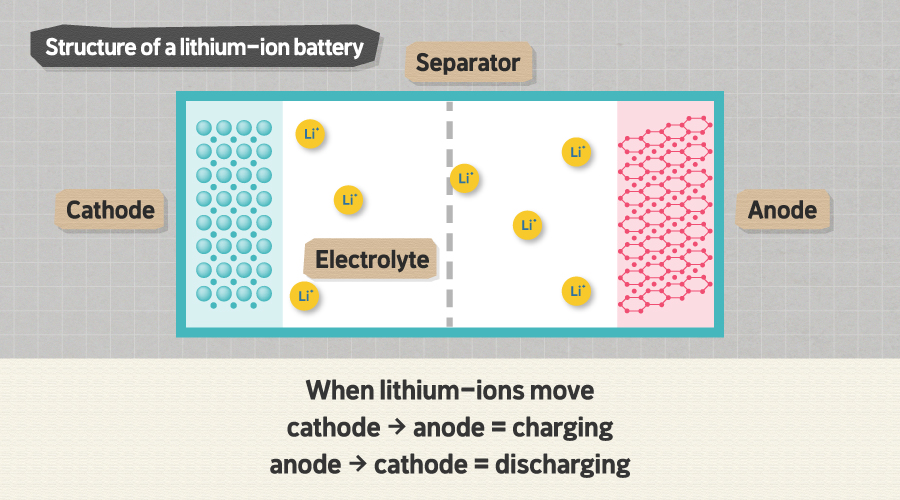
[Lithium-ion batteries consist of cathode, anode, electrolyte, and separator.]
Zooming in on the separator's surface reveals fine, 10–500 nanometer (nm) pores. These pores serve as pathways for lithium ions. Lithium ions are only about 0.07 nm in size, allowing them to pass through the pores between the anode and cathode.
One factor in determining separator performance is the air permeability time*. A shorter air permeability time allows lithium ions to move more rapidly and in greater quantities, making it advantageous for fast charging. Accordingly, SAMSUNG SDI is developing separators to reduce the air permeability time.
*Air permeability time: A metric indicating the time (seconds) it takes for 100cc of air to pass through the separator
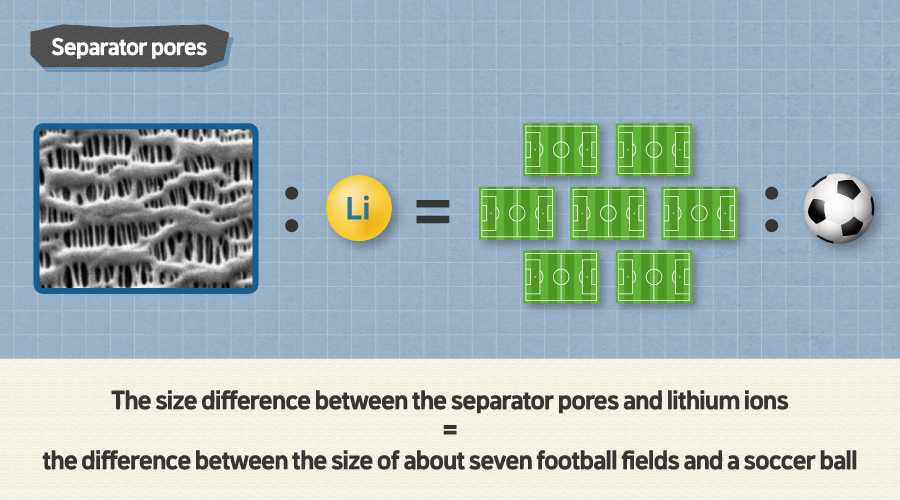
[Lithium ions move through the pores in the separator. If lithium ions were soccer balls, the pores would be about 7 football fields in size.]
The separator also plays a role in blocking lithium-ion movement and stopping the current flow when abnormalities occur inside the cell.
Separators are made of polyethylene (PE) or polypropylene (PP), which are types of plastic similar to the film we see in everyday items. If the internal cell temperature abnormally rises, the separator shrinks, clogging the pores to ensure safety. This works on the same principle as plastic film shrinking when exposed to intense heat.
However, problems arise if the separator shrinks excessively and deforms. This is because the separator can no longer properly prevent contact between the cathode and anode. To address this, Samsung SDI applies a technology where the separator surface is coated with a ceramic layer. This ensures the separator maintains its original shape even at high temperatures.
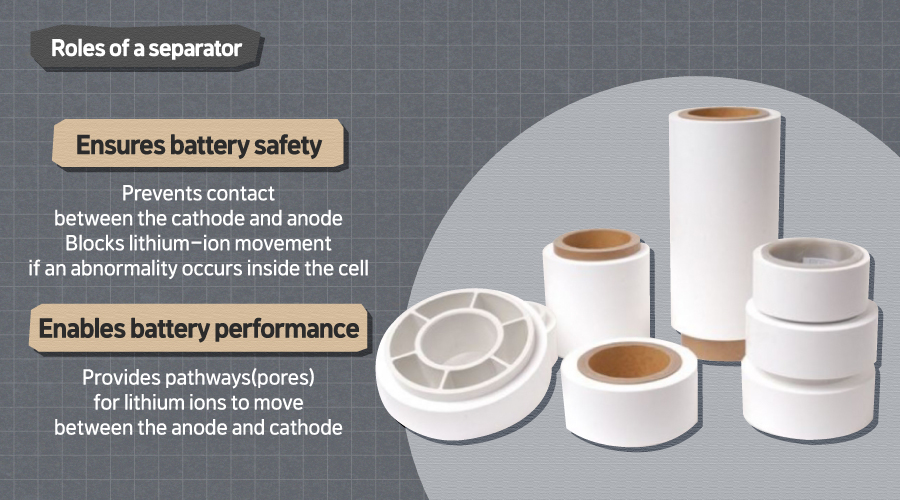
[The Separator is an essential material that ensures battery safety and enables battery performance.]
Remember, the separator plays a critical role by providing a pathway for lithium ions to move while blocking them during abnormal conditions, thereby ensuring safety and enabling performance!

SAMSUNG SDI Newsroom
We deliver the latest news and issues coming out of SAMSUNG SDI.