Technology & Products
[Battery Manufacturing] Formation Process: Bringing Life to Batteries
2025.09.18
|
[Battery Manufacturing] This is a series introducing SAMSUNG SDI’s key battery manufacturing processes. It delivers the core roles and technical characteristics of each of the four processes—electrode, stacking, assembly, and formation—using infographic images. |
How are batteries installed in electric vehicles and various IT devices made? The [Battery Process] series has previously introduced electrode processes, stacking processes, and assembly processes. This article explores the formation process, which is the final stage of the battery manufacturing process.
Based on prismatic batteries, once the electrode process that creates cathode and anode electrodes is completed, a stack is formed through the stacking process that stacks these electrodesand separators. In the subsequent assembly process, the stack created from the previous processes is inserted into a hexahedral-shaped rigid can.
After completing the electrode - stacking - assembly processes, the battery has a complete appearance and internal structure, but it cannot perform its role as a battery. The process that gives life to the battery at this point is the formation process. It imparts electrical characteristics to the cell and identifies defects, enabling the battery to function properly. This is closely related to the battery's safety and lifespan.
* Read more → ①Electrode, ②Stacking Process ③Assembly Process (Click)
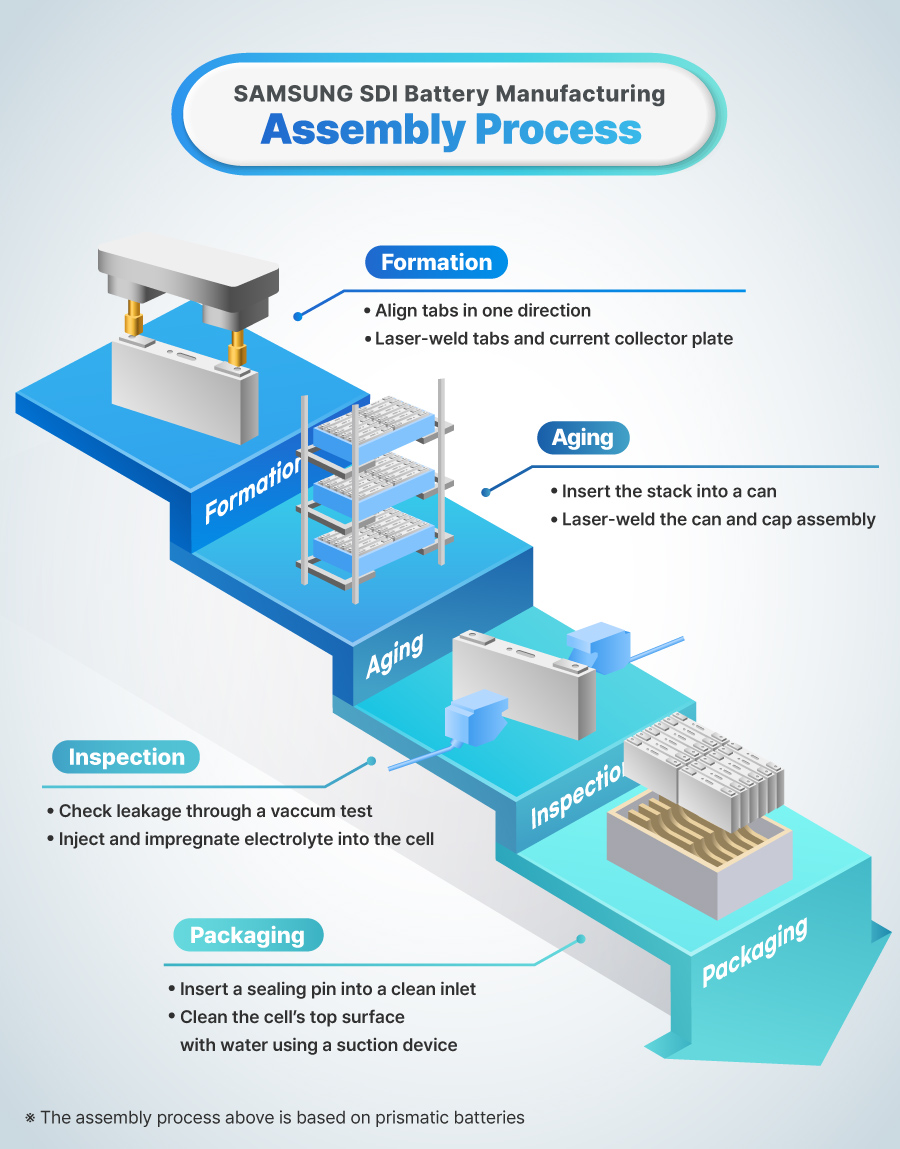
The formation process consists of a total of four stages as follows: charge/discharge process, aging process, property inspection, and packaging process.
Charge/Discharge Process
The charge/discharge process is a process that imparts electrical properties to the cell by repeatedly charging and discharging.
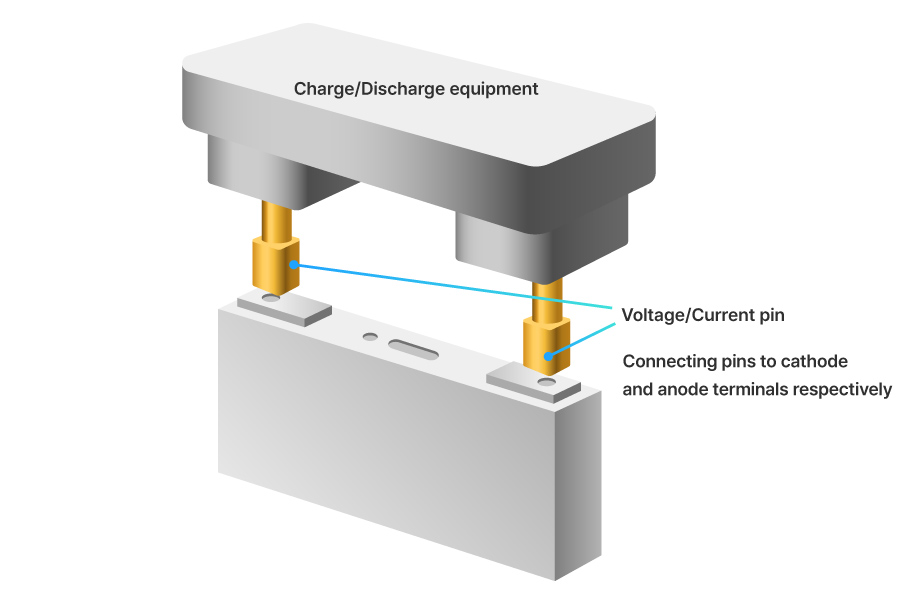
Charge/discharge is an important process where the cell's lifespan and properties are determined according to charging and discharging conditions.
The process of charging a fully assembled cell for the first time is called pre-charging, during which SEI layer is formed. SEI layer is a thin layer that forms on the surface of the anode. This becomes a passage for lithium ions to enter and exit, and it plays a role in preventing damage by suppressing unintended reactions on the anode surface during battery use.
Meanwhile, during pre-charging, the interface between the cathode and anode is formed, chemical reactions occur, and byproducts are consequently generated. Because these byproducts have a negative effect on the battery's performance and safety, pre-charging should be done with appropriate conditions suitable for the cell design. After pre-charging, additional charging and discharging are carried out, collectively referred to as the charge/discharge process.
Aging Process
The aging process stores the cell for a certain period and stabilizes voltage.
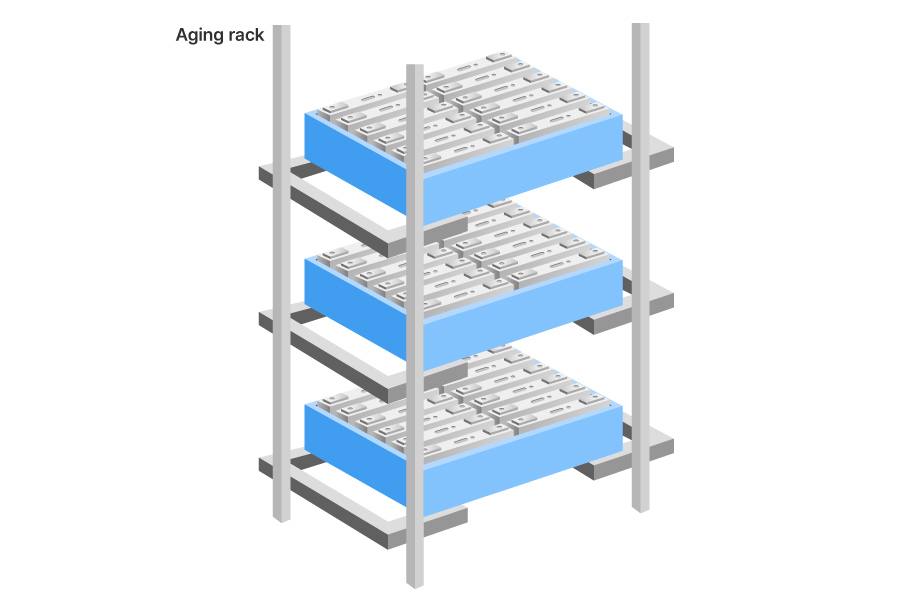
The voltage of a cell that has received electrical energy gradually decreases as it reaches chemical equilibrium. For this reason, a battery gradually discharges on its own when left unused in daily life. However, when measuring voltage immediately after cell charge and discharge the voltage increases, or decreases at a very fast speed due to the influence of charge/discharge. Therefore, for the battery to stabilize after charge/discharge, a certain degree of aging process is necessary, and this process is called 'aging'.
The aging process uses more time and space compared to other processes. This is because the battery needs a certain period to stabilize, and an aging room with strictly controlled temperature and humidity must be prepared. Therefore, deriving ideal temperature and duration suitable for product characteristics and thereby increasing productivity is the core technology of the relevant process.
Property Inspection
Property inspection is the stage that confirms whether the cell's performance characteristics meet the required specifications.
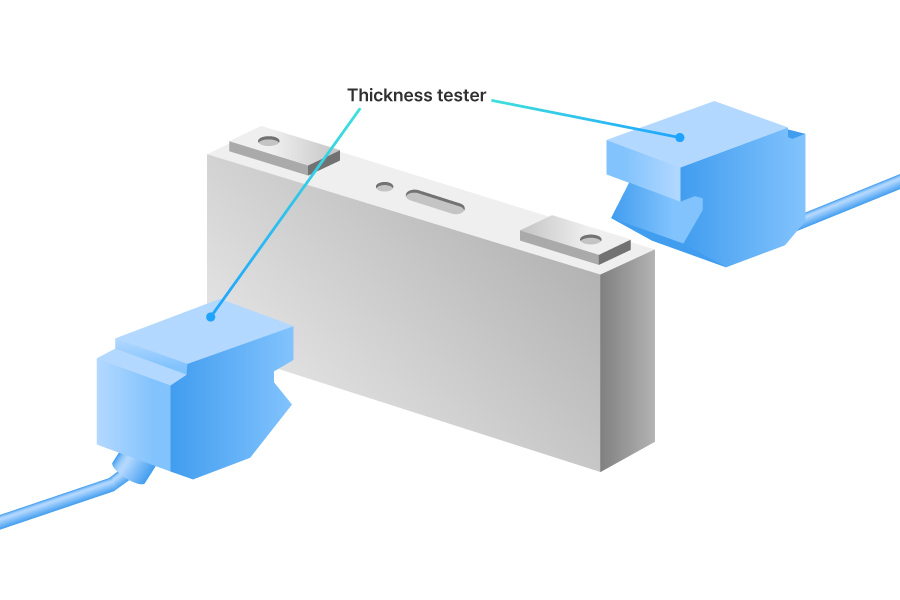
When producing products, it is essential to verify that various product properties fall within the specifications promised with customers. These include capacity, voltage, and thickness. The stage that confirms these characteristics is called property inspection. In property inspection, accurately measuring the promised characteristics within the given time is important so that unsuitable products are not delivered to customers.
Property inspection is conducted across all processes. Specifically, during the charge/discharge process, capacity and voltage is measured through charging and discharging. Afterward, in the aging process, the cell is further inspected to ensure that no foreign substances are activated inside. Subsequently, in the packaging process, the thickness of the cell is measured.
Packaging Process
The packaging process consists of inspecting the battery’s exterior condition and packaging for shipment.
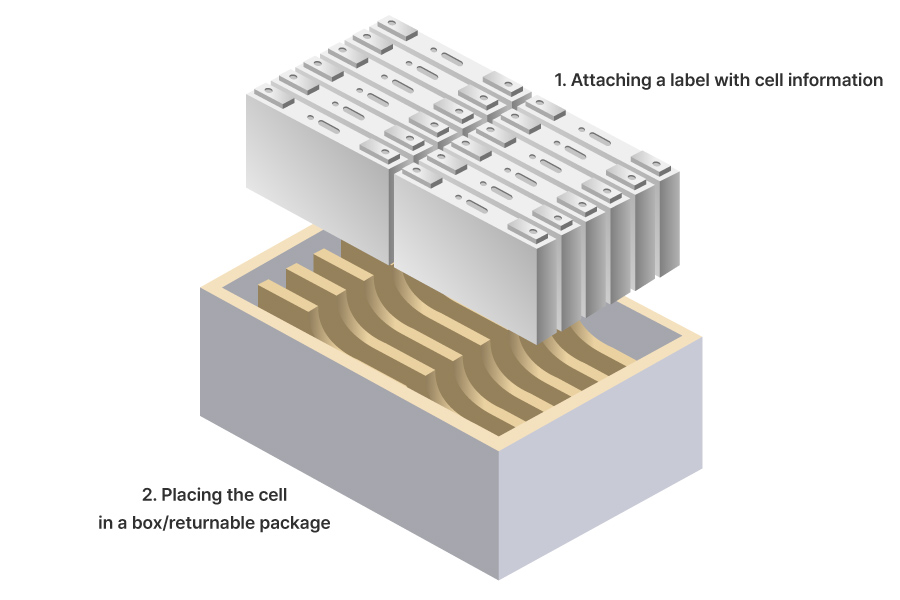
First, after attaching insulation tape to the outside of the cell, voltage is applied to check for any leakage current. Through this, even invisible insulation breakdown can be identified.
After conducting appearance inspection that screens for cell dents, scratches, contamination, etc., a label with cell information is attached. Finally, when the cell is placed in a box or returnable package and sealed, the process is completed. Because defective products, if not detected at this stage, are delivered directly to customers, strict management is required.
Returnable package is an eco-friendly packaging container that SAMSUNG SDI adopted. When cells are delivered to customers in the designated containers, the empty boxes are collected and reused, thereby reducing unnecessary packaging waste.

SAMSUNG SDI Newsroom
We deliver the latest news and issues coming out of SAMSUNG SDI.