Technology & Products
HEV, PHEV, EREV, EV… Different Types of EVs and Their Battery Features
2026.07.23
|
□ HEVs use a motor to assist the engine, improving fuel efficiency □ PHEVs add an externally rechargeable battery to extend electric-only range □ EREVs run on battery power, with the engine acting solely as a generator to extend range □ BEVs run entirely on battery power, with no engine at all |
Growing global EV sales have recently sparked greater interest in the different types of electric vehicles. EVs vary in their drive systems—hybrid electric vehicles (HEVs), plug-in hybrid electric vehicles (PHEVs), extended-range electric vehicles (EREVs), and battery electric vehicles (BEVs)—with their structure and driving modes shifting depending on how much the internal combustion engine is involved. These differences also shape the distinct battery characteristics of each type.
Hybrid Electric Vehicle (HEV)
A hybrid electric vehicle (HEV) pairs a conventional engine-powered vehicle with an electric motor and battery. Fossil fuel remains the primary power source, with electricity playing a supporting role. At high speeds, where the engine runs efficiently, the vehicle relies on the engine alone; at low speeds or when starting off, where engine efficiency drops, the electric motor takes over.
Because battery capacity is relatively small, HEVs don’t need external charging—the battery instead recharges from energy generated during engine operation or deceleration. This makes output performance the critical factor for HEV batteries.
![[Structure and Features of the HEV]](https://news.samsungsdi.com/data_assets/global/editors/20260722164730_.jpg "[Structure and Features of the HEV]")
[Structure and Features of the HEV]
Plug-in Hybrid Electric Vehicle (PHEV)
A Plug-in Hybrid Electric Vehicle (PHEV) is designed to be charged from an external power source. It can travel a certain distance on the electric motor alone, and once the battery runs low, it operates like a standard hybrid, maximizing fuel savings. Typically, the motor handles city driving while the engine takes over for highway speeds or longer trips.
Because electric-mode driving is possible, PHEV batteries need higher energy density and greater capacity than those found in HEVs.
![[Structure and Features of the PHEV]](https://news.samsungsdi.com/data_assets/global/editors/20260722164805_.jpg "[Structure and Features of the PHEV]")
[Structure and Features of the PHEV]
Extended-Range Electric Vehicle (EREV)
The industry has also been paying closer attention to Extended-Range Electric Vehicle (EREV). These typically run on the electric motor alone, but when the charge runs low, the engine engages as a generator to recharge the battery. What sets EREVs apart is that the engine does not directly power the wheels—it is simply extends the range while preserving the driving characteristics of a true EV.
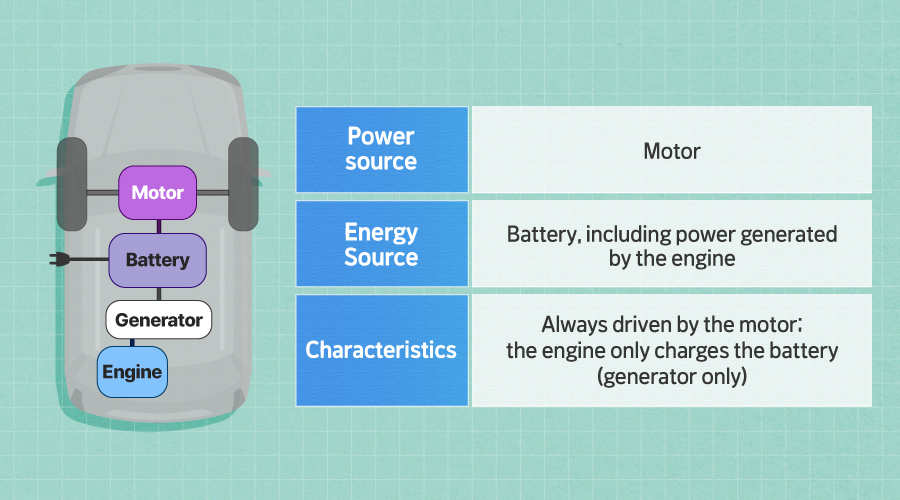
[Structure and Features of the EREV]
Battery Electric Vehicles (BEV)
Battery electric vehicles (BEVs) run entirely on electric motors, with no internal combustion engine at all. This gives them relatively low noise and vibration, along with zero tailpipe emissions.
Since they draw power solely from the battery, both output and capacity are critical—and charging speed matters just as much, given how large that battery capacity is.
As a result, BEV batteries must combine high energy density with reliable control across a large number of cells. That raises the stakes for thermal management systems, which handle heat buildup during fast charging, and for the Battery Management System (BMS), which continuously monitors battery health.
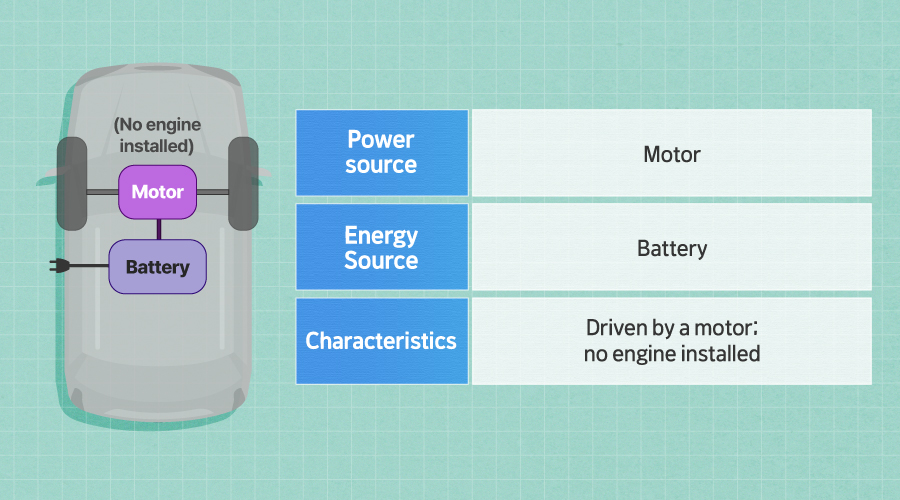
[Structure and Features of the BEV]
Because battery specifications differ across EV types, SAMSUNG SDI is building a diverse product portfolio spanning both prismatic and cylindrical form factors to meet the market’s needs. The company holds more U.S. patents for prismatic batteries than any competitor—around 1,200 registered by the end of 2025, a clear mark of its differentiated technology. On the cylindrical form factor, the company continues to diversify its lineup, having launched mass production and supply of 46-phi batteries last year.
Beyond this, SAMSUNG SDI is sharpening its edge further with “SolidStack”, an all-solid-state battery built for improved safety and energy density.
Related Articles)
The Source of Confidence in Prismatic Batteries Lies in Patent Expertise
From Robots to EVs: Powered by Next-Gen ASSB
![[SAMSUNG SDI’s prismatic and cylindrical batteries]](https://news.samsungsdi.com/data_assets/global/editors/20260722164927_.jpg "[SAMSUNG SDI’s prismatic and cylindrical batteries]")
[SAMSUNG SDI’s prismatic and cylindrical batteries]
SAMSUNG SDI remains committed to expanding its portfolio in support of the full range of EV types, drawing on its distinctive technological capabilities.

SAMSUNG SDI Newsroom
We deliver the latest news and issues coming out of SAMSUNG SDI.