Technology & Products
From Robots to EVs: Powered by Next-Gen ASSB
2026.07.07
|
□ Surging ASSB demand due to their superior safety and high energy density, driven by growth in the physical AI and EV markets □ ASSB exhibit distinct characteristics depending on whether they use sulfide, oxide, or polymer solid electrolyte materials □ SAMSUNG SDI maximizes energy density by combining highly conductive sulfide electrolytes with proprietary anode-free technology |
The battery industry is looking beyond EVs and even reaching to robotics, often hailed as physical AI. As robots become more integrated into daily life, they require batteries that are safer, lighter, and able to run longer on a single charge. All-Solid-State Batteries (ASSB) meet these requirements by improving safety and energy density, making them a game changer for both future mobility and robotics.
How different ASSB electrolytes compare
The main feature of an ASSB is its solid electrolyte, which is one of the four key battery components of a battery. Utilizing a solid form for this component improves both battery safety and energy density. The solid electrolytes are generally categorized into three main types, each with its own trade-offs. Sulfide-based electrolytes have high ionic conductivity, which leads to better battery performance. They are also easier to adapt for mass production, which is why current industry efforts are heavily focused on developing large-scale manufacturing for them.
In contrast, oxide-based electrolytes offer excellent stability, but their low ionic conductivity limits performance, and they require complex manufacturing processes. Polymer-based electrolytes work well with existing manufacturing setups, making them cost-effective and useful for lightweight batteries, though their low ionic conductivity results in weaker performance.
SAMSUNG SDI’s technological development and infrastructure scaling
SAMSUNG SDI is focusing its efforts on sulfide-based ASSB technology to improve overall battery performance.
The company uses its own self-developed solid electrolytes and innovative anode-free technology in its ASSB line, named “SolidStack.” This approach minimizes the space taken up by the anode, leaving more room for cathode materials, which increases the battery’s energy density.
To meet different industry needs, SAMSUNG SDI is also expanding its battery formats by developing pouch type batteries for robots and prismatic versions for EVs, optimizing the design for each specific environment and performance requirement.
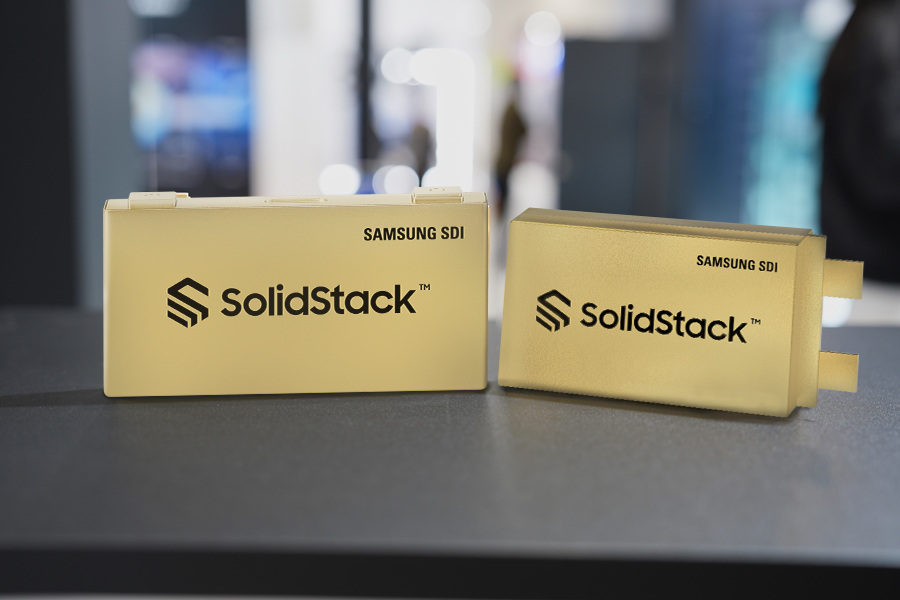
[SAMSUNG SDI’s ASSB SolidStack diversifies into prismatic and pouch form factors]
As part of this roll out, SAMSUNG SDI built Korea’s first ASSB pilot line in March 2023, within prototype production beginning at the end of that year. Samples are currently being tested by major customers while the company refines its manufacturing processes and sets up supply chains to prepare for full mass production.
Using its outstanding technological capabilities and accumulated battery production experience, SAMSUNG SDI is fully dedicated to advancing ASSB development to capture an early lead in the growing markets for robotics, AI, and future mobility.

SAMSUNG SDI Newsroom
We deliver the latest news and issues coming out of SAMSUNG SDI.