Technology & Products
SAMSUNG SDI’s Next-Generation Batteries Powering the Future
2026.09.03
|
□ Demand for high performance batteries rises with the growth of emerging industries such as robots, humanoids, and UAM □ SAMSUNG SDI accelerates development of next-gen battery technologies, including all-solid-state, sodium-ion, and lithium metal batteries □ The company pushes forward to lead the future market by leveraging its next-gen battery portfolio |
The battery market is rapidly expanding beyond EVs and ESS(Energy Storage System) into robots, humanoids, UAM(Urban Air Mobility), and aerospace. In line with this trend, SAMSUNG SDI is investing its resources to lead the future market while strengthening its leadership in the EV and ESS markets.
Why are next-generation batteries gaining traction?
In these emerging industries, smaller, lighter batteries that deliver stronger power for longer periods are increasingly in demand.
Robots and humanoids require batteries with high energy density that can operate for extended periods while ensuring safety and durability. In the UAM and aerospace sectors, where applications must perform optimally within limited space, ultra-lightweight design and high power output are emerging as key battery capabilities.
SAMSUNG SDI focuses on next-gen batteries—all-solid-state, sodium-ion, and lithium metal
To meet the diverse requirements of future markets, SAMSUNG SDI is developing next-generation battery technologies, including all-solid-state, sodium-ion, and lithium metal batteries.
All-solid-state batteries, which use solid electrolytes to improve safety and energy density, are considered the leading contenders among next-generation batteries. SAMSUNG SDI uses proprietary solid electrolyte and anode-free technology to further enhance their performance. It has also diversified its product portfolio to offer customer-tailored solutions, such as pouch-type batteries for robot applications and prismatic-type batteries for EV applications.
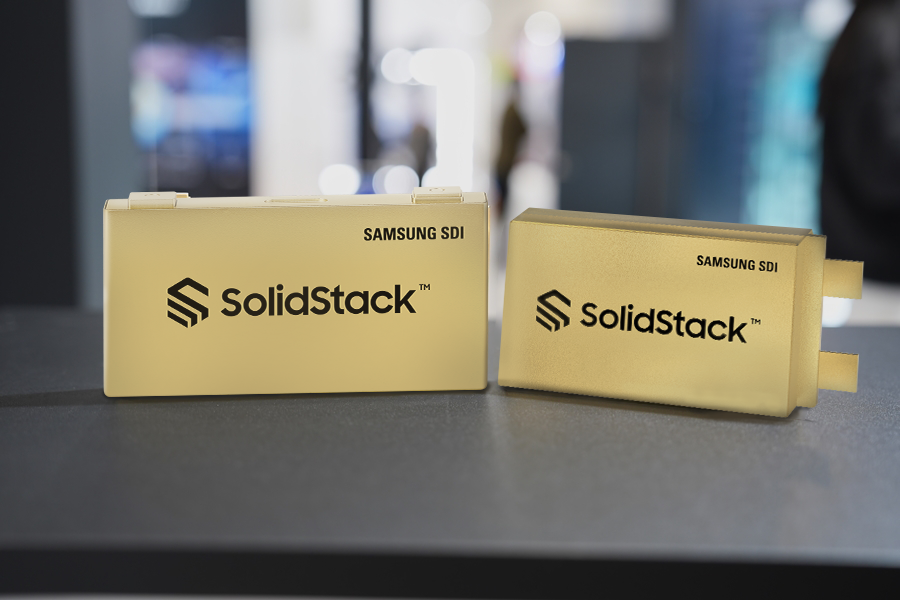
[SAMSUNG SDI’s all-solid-state battery, SolidStack]
Although sodium-ion batteries have relatively low energy density, their active materials are based on sodium carbonate—an abundant resource—giving them a clear advantage in supply stability and cost. These batteries also offer superior characteristics such as long lifespan, high power output, and stable operation at low temperatures. Building on these strengths, SAMSUNG SDI is conducting R&D on sodium-ion batteries for ESS and UPS applications.
Lithium metal batteries offer high energy density and light weight, but their lifespan and safety remain relatively limited. Accordingly, SAMSUNG SDI is collaborating research institutes at home and abroad to advance related technologies. In February 2026, its lithium metal battery research, conducted through academic-industrial cooperation with Columbia University, was featured in Joule, one of the most prestigious journals in the energy field. Lithium metal batteries are expected to be used in the UAM and aerospace sectors thanks to their high energy density.
Behind these achievements lies SAMSUNG SDI’s sustained investment in R&D. The company spent 1.4 trillion won on R&D in 2025, a 9.5% increase from 2024.
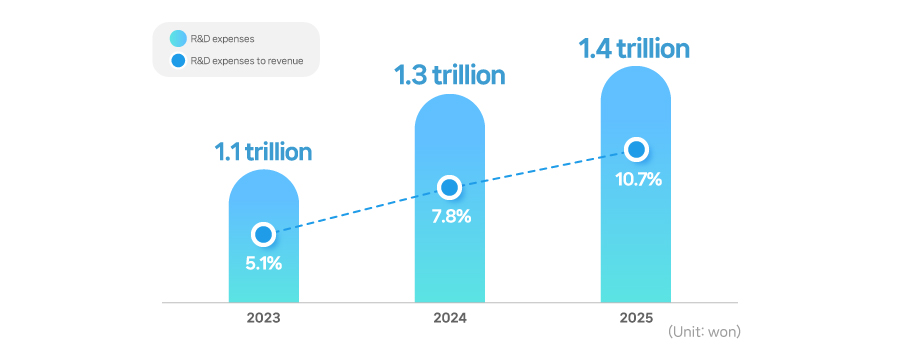
[SAMSUNG SDI advances next-gen battery technologies through sustained investment in R&D]
Leveraging its next-generation battery technologies, SAMSUNG SDI will expand into future industries such as robots, humanoids, UAM, and aerospace, moving beyond the EV and ESS sectors.

SAMSUNG SDI Newsroom
We deliver the latest news and issues coming out of SAMSUNG SDI.