Technology & Products
The Core of ESS Reliability—SAMSUNG SDI’s Thermal Management Technology
2026.08.27
|
□ Temperature control is essential to maximizing the performance and safety of ESS batteries □ The adoption of a liquid-cooling thermal management system enhances ESS reliability □ A proprietary cooling system optimized for the SBB elevates operational efficiency |
As AI data centers and renewable energy generation ramp up these days, the spotlight is turning to ESS(Energy Storage System). The ESS is becoming the key infrastructure to ensure a reliable power grid, and thermal management technology which affects the reliability of the system over the long term is in the spotlight as well.
Thermal management determines the performance and safety of the ESS
Temperature changes impact power efficiency, charging and discharging performance, and lifespan and other properties of a battery. Therefore, stable thermal management is a critical factor in ESS operation. Maintaining proper temperature is particularly important to maximize the battery’s performance and safety in the ESS.
To control the ESS temperature stably, SAMSUNG SDI uses a liquid-cooling system, which offers higher heat transfer efficiency than conventional air-cooling systems and helps maintain a uniform temperature throughout the system.
An integrated cold plate is placed at the bottom of the battery modules, and as coolant circulates through it, the system absorbs heat from the battery when temperatures are high and releases heat when temperatures are low. In this way, temperature fluctuations within the system are minimized.
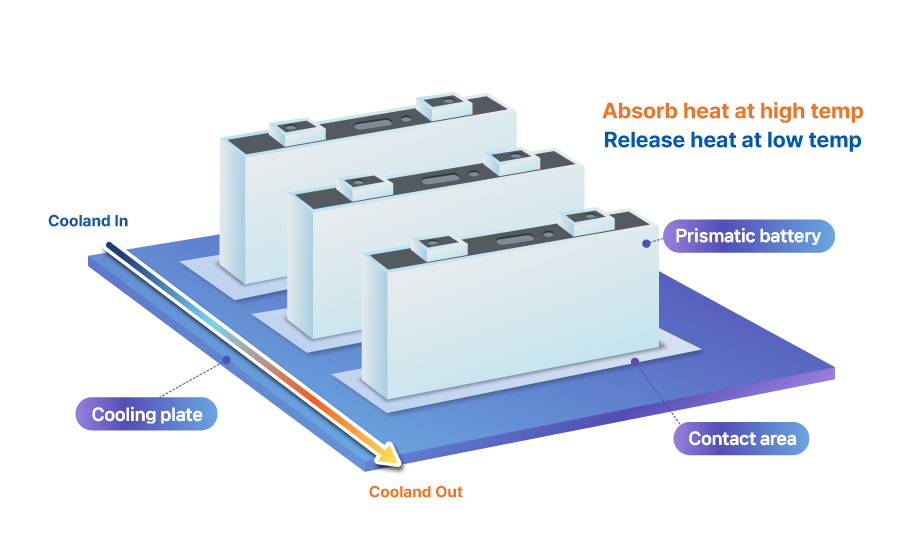
[The cooling plate in the battery modules minimizes temperature fluctuations by efficiently controlling heat]
Proprietary thermal management system tailored for SBB
What sets the thermal management system apart is cooling control technology and energy usage optimization which promptly respond to external environment changes.
As ESS are installed outdoors, maintaining a consistent internal temperature—even during heatwaves or freezing cold—is essential. SAMSUNG SDI utilizes temperature sensors in the modules to quickly detect temperature changes and precisely control the ESS’s internal temperature by coordinating with the cooling system. Also, the company optimizes the operating algorithm for the energy-intensive cooling unit based on charging and discharging data, lowering its power consumption.
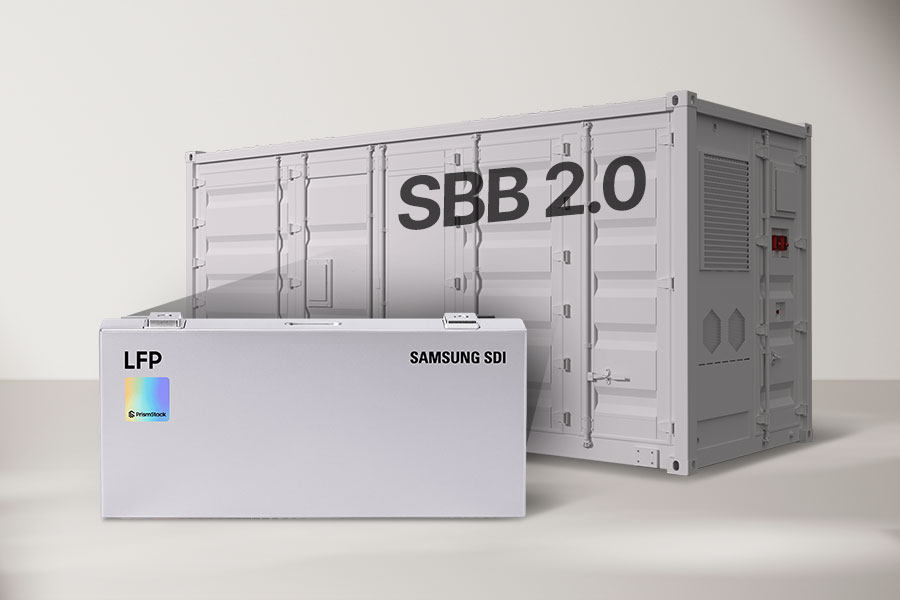
[SBB(Samsung Battery Box) 2.0, an ESS solution incorporating LFP batteries ]
SAMSUNG SDI applies the thermal management system to the SBB(Samsung Battery Box), a container-based ESS, where it contributes to improving the system’s operational efficiency and reliability.
Along with the thermal management system, the SBB incorporates EDI(Enhanced Direct Injection) and SBI(Samsung Battery Intelligence), ensuring a high level of safety.
SAMSUNG SDI will lead the global ESS market based on product reliability, including its unrivaled thermal management technology.

SAMSUNG SDI Newsroom
We deliver the latest news and issues coming out of SAMSUNG SDI.