Technology & Products
Digital Twins and AI Integrate into R&D to Boost Battery Performance and Safety
2026.06.18
|
□ SAMSUNG SDI utilizes AI and digital twins to advance battery development and safety management □ SBI safety system for ESS leverages field and virtual data to predict abnormalities □ Digital twins enhance battery performance and verify safety in real-time |
As the race for battery technology intensifies, speeding up development while securing a cost advantage is becoming a critical challenge. Market demands for performance and safety have become strict, yet the actual development and validation require significant time and capital. To solve this, SAMSUNG SDI is accelerating the development of core safety technologies by blending AI with R&D simulations. Leveraging its previous deep data science capabilities, the company is building a robust digital twin environment right at the R&D level.
Specifically, SAMSUNG SDI is using data generated across the entire R&D lifecycle, along with real-world field data, to boost development efficiency and product performance. By combining Field Intelligence (based on actual operational data) with R&D Intelligence (which generates virtual data from simulations), SAMSUNG SDI can predict battery behavior with higher accuracy while cutting down R&D timelines.
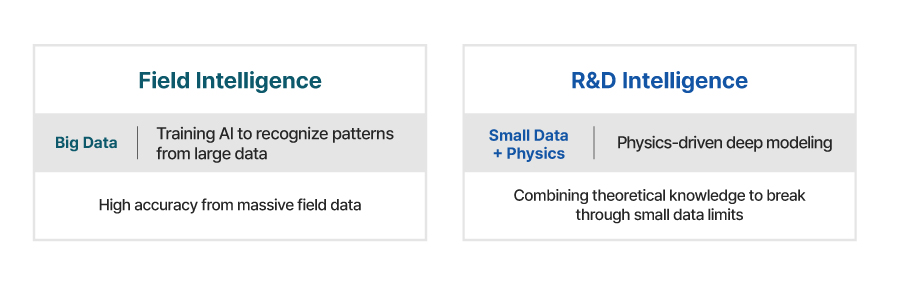
[SAMSUNG SDI combines Field Intelligence with R&D Intelligence]
SBI, an intelligent safety system for ESS: built on integrative data science
A prime example of this data science strategy in action is SBI(Samsung Battery Intelligence), an intelligent safety system designed for ESS. SBI is an AI-driven system that diagnoses battery health, flags potential cell anomalies, and predicts shifts in battery lifespan.
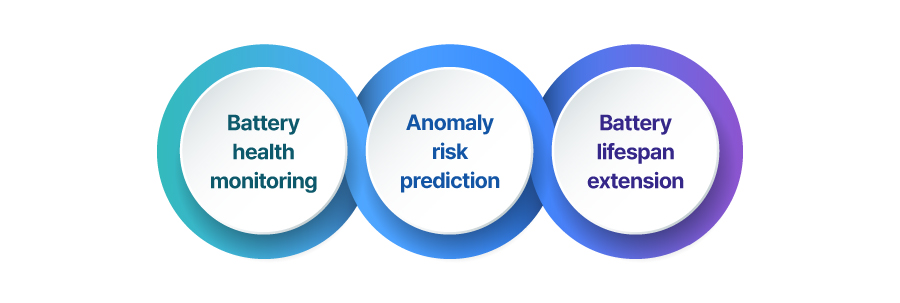
[Three main features of SBI]
The system relies on two data science capabilities that SAMSUNG SDI has built. First, it is fed by accumulated actual data from operational ESS sites, teaching the system to monitor active facilities and spot abnormal patterns.
Second, for new products that lack extensive field data, SBI utilizes virtual data from simulations. By using virtual models that mirror true battery characteristics to analyze various scenarios and feeding those outcomes into the AI training, SBI can be applied to products even before they are deployed in the field.
Through this approach, SBI leverages both operational and virtual data to deliver consistent, AI-powered safety management across all product generations.
A virtual battery lab redefines testing through digital twins
Beyond AI, SAMSUNG SDI is using digital twin technology to transform how batteries are developed. This approach creates a model battery in a virtual environment that replicates the exact conditions of its physical counterpart.
When applied to charge-discharge evaluations, the virtual model operates in tandem with the actual battery during testing. Researchers can monitor cell status in real time on a screen throughout the evaluation, allowing them to quickly catch abnormalities. What used to be visible only after an experiment concluded can now be tracked live.
By establishing a digital twin system that directly links physical evaluation equipment with digital models, SAMSUNG SDI ensures both the physical and model batteries run concurrently. This significantly reduces overall development time and eliminates the costs of repeated physical experiments.
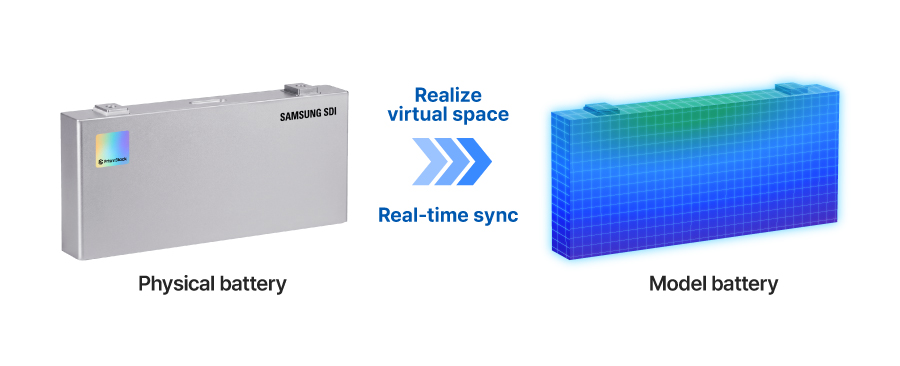
[A virtual battery realized through a digital twin]
From SBI and digital twins to exclusive Vision AI optimization, SAMSUNG SDI is embedding data science into various areas, continuously raising the bar for battery performance and safety.
Moving forward, SAMSUNG SDI will build on this integrative data science foundation, strengthening its edge in next-generation battery tech by continuously advancing the integrative platform that connects its R&D and field operations.

SAMSUNG SDI Newsroom
We deliver the latest news and issues coming out of SAMSUNG SDI.