Technology & Products
[BoT] What Are the Roles of EVs and Batteries in the Era of Autonomous Driving?
2026.05.26
|
The era of ‘BoT (Battery of Things)’—where batteries become the core of everything around us—is drawing near. From robots and IT devices to electric vehicles, batteries already serve as the driving force behind countless machines. Here, we look at the battery characteristics for each application and SAMSUNG SDI’s leading technologies. |
As autonomous driving technology enters a full-fledged commercialization phase, EVs and batteries, the core foundation of the system, are stepping into the spotlight. For advanced autonomous driving systems to function reliably, a stable power supply and effective energy management determine the ultimate success of the technology.
Autonomous driving system and EVs: the best partners
Autonomous driving technology allows vehicles to perceive their surroundings, make decisions, and travel to a destination without human intervention. It works by using numerous sensors embedded throughout the vehicle to collect data, which AI then analyzes to assess the road and control the car.
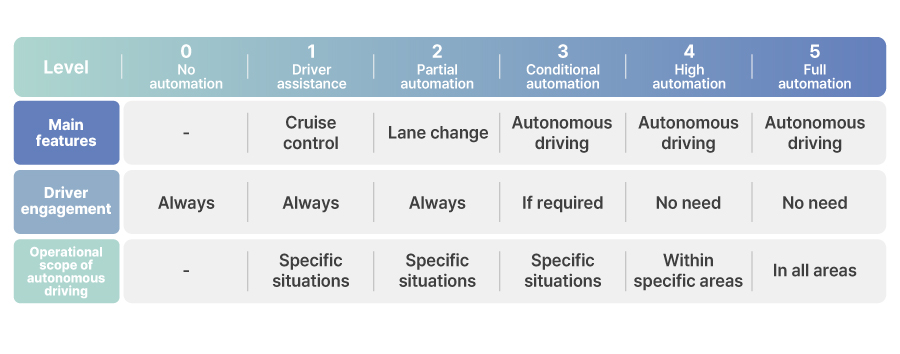
[Autonomous driving levels as classified by SAE International]
Since processing massive amounts of data at high speeds in real time is the heart of the system, EVs provide a perfect platform for the autonomous driving. The vehicle’s battery acts as a stably power source for both the sensors and high-performance computing devices, while the BMS(Battery Management System) manages this power output with efficiency.
Additionally, because EVs control their motors entirely via electrical signals, they can process autonomous driving commands with high precision, giving them a significant advantage in vehicle control.
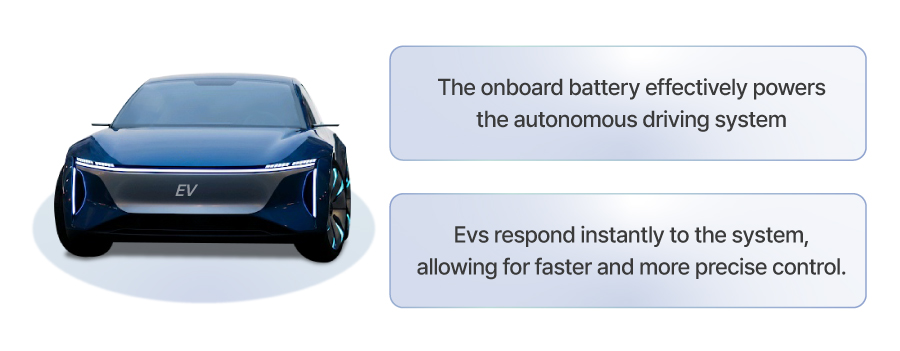
[Why EVs have an advantage in autonomous driving]
High energy density, high power, and safety: battery requirements for autonomous driving
To improve the maturity of autonomous driving technology, batteries must offer exceptional performance. First, high energy density is essential so batteries can simultaneously power AI processing units while also providing the EV’s driving power. Second, they must also exhibit high power characteristics that allow for rapid control over the vehicle’s power in unexpected situations. Finally, safety is a critical consideration. As autonomous vehicles place a continuous load on the battery, excellent thermal management is crucial.
SAMSUNG SDI’s prismatic battery, “PrismStack,” achieves high energy density and capacity with its “Stack” design structure that efficiently uses internal space. The company has also enhanced fast charging capabilities and high power performances through a design that minimizes internal resistance.
Moreover, its aluminum-canned structure incorporates advanced safety features that facilitates heat dissipation, alongside No TP(No Thermal Propagation) technology that prevents heat from spreading between cells. This ensures the high level of safety essential for automotive batteries.
Autonomous driving technology is expanding into various fields, including urban driving, unmanned delivery, and robotaxis. SAMSUNG SDI will respond to evolving mobility era through differentiated technologies and a wide range of battery products.

SAMSUNG SDI Newsroom
We deliver the latest news and issues coming out of SAMSUNG SDI.