Technology & Products
[Battery Talk Talk] Can Batteries Be Made Out of Sodium?
2026.05.12
|
[Battery Talk Talk] From simple curiosities to insight-driven questions, let’s walk through “all about battery” briefly. |
Can we actually build a battery using salt? It’s not a far-fetched idea; in fact, it is possible. In this article, we dive into sodium batteries, which have recently been gaining traction among non-lithium batteries.
Sodium vs. Lithium-ion: similar but different?
Sodium batteries are similar to lithium-ion batteries regarding their internal structure and operating principles. Both consist of four key components: the cathode, anode, electrolyte, and separator. The primary difference lies in the cathode, where sodium batteries use sodium-based materials instead of lithium. Because the production processes are so alike, manufacturers can often utilize existing lithium-ion battery production lines to build them.
Just as lithium-ion batteries are categorized into types like NCA(Nickel-Cobalt-Aluminum) or LFP(Lithium-Iron-Phosphate) based on their cathode materials, sodium batteries use different active materials such as NFM(Nickel-Iron-Manganese) and NFPP(Sodium-Iron-Pyrophosphate-Phosphate). While NFM offers higher energy density, NFPP holds the advantage when it comes to a longer lifespan and enhanced safety.
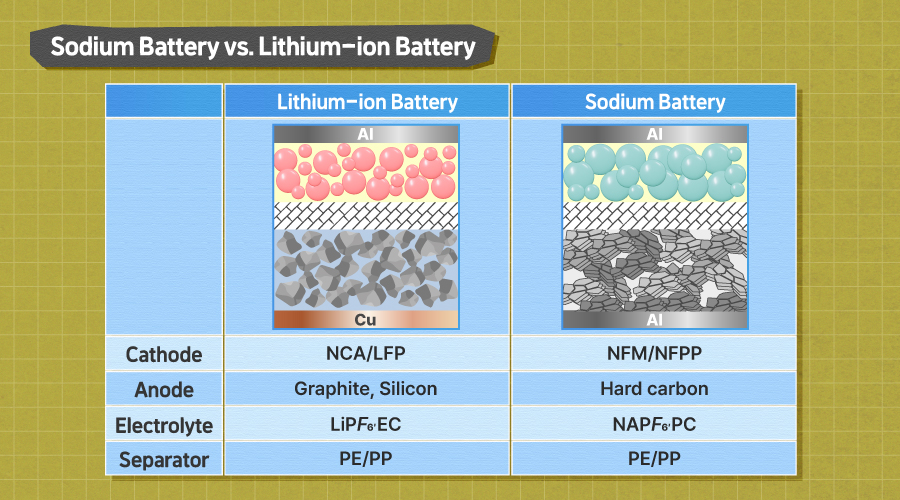
[Comparison of sodium and lithium-ion batteries]
Why sodium batteries are in the spotlight: addressing cost and performance
Currently, the energy density of sodium batteries is lower than that of lithium-ion batteries. Despite this disadvantage, they are gaining attention because their strengths often outweigh this specific weak point.
The key advantage of the sodium battery is price competitiveness. Sodium carbonate, the primary raw material for the cathode, is abundant and easy to source, ensuring a stable supply. Its price volatility is also relatively low. This makes it a much more reliable option compared to lithium, which is sensitive to raw material market fluctuations.
As material technology advances and mass supply system is established, cost savings are expected to grow. This will help compensate for energy density limitations and strengthen market competitiveness.
A long cycle life and excellent low-temperature performance are other notable strengths. Hard carbon, used as the anode material, undergoes very little volume change during charging and discharging, which helps the battery lasts longer. Furthermore, sodium ions can move rapidly, enabling high power output.
Additionally, the electrolyte in sodium batteries has a lower freezing point than that of lithium-ion batteries, allowing them to maintain stable performance at low temperatures.
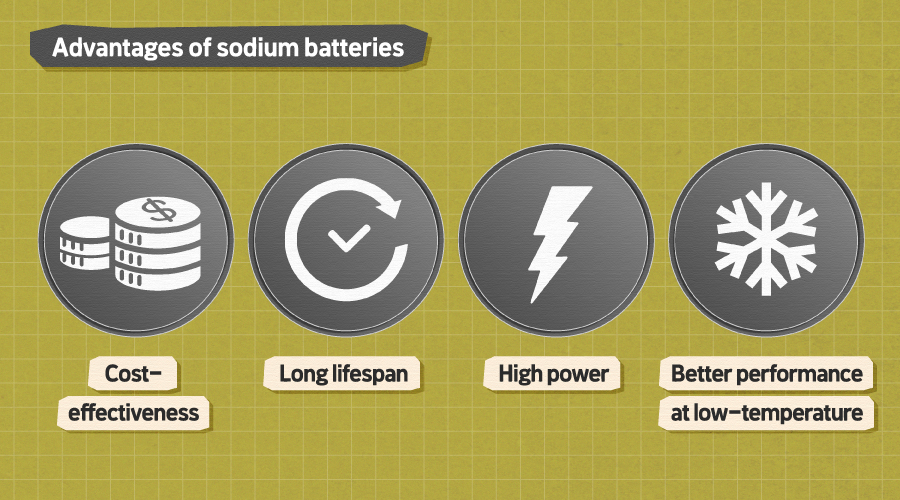
[Advantages of sodium batteries]
The AI age suggests a new option: sodium batteries
With the rapid expansion of AI and the resulting surge in data centers, there is a growing demand for batteries in Uninterruptible Power Supply (UPS). Since UPS prioritizes high power and long lifespans, sodium batteries are emerging as a strong choice.
SAMSUNG SDI is actively securing next-generation technologies, including sodium batteries, to respond to these market trends. By offering a diverse battery portfolio that meets specific customer requirements, the company will strengthen its competitiveness in the global market.
[Battery Talk Talk] will be back with another insightful topic!

SAMSUNG SDI Newsroom
We deliver the latest news and issues coming out of SAMSUNG SDI.