Technology & Products
[SDI Focus] NCA and NCM for High Performance, LFP for Stability—SAMSUNG SDI’s Material Strategy Tailored to Application
2026.05.07
SAMSUNG SDI is drawing attention in the market, recently signing a series of large-scale supply agreements with global automotive brands and energy companies. After securing a KRW 1.5 trillion of contract in March to supply batteries for ESS to a U.S. energy company, the company signed a multiyear agreement with Mercedes-Benz in April to supply batteries for next-generation EVs.
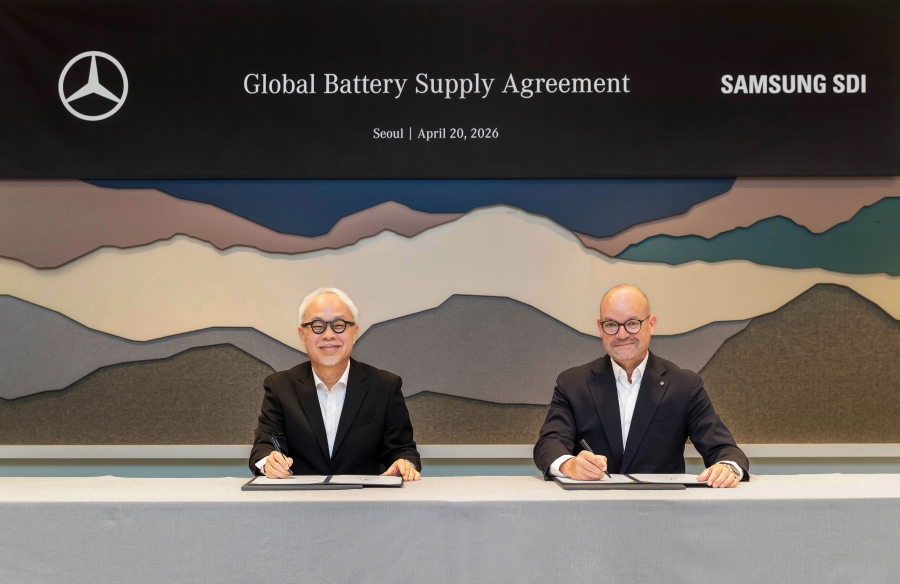
[SAMSUNG SDI and Mercedes-Benz signed an EV battery supply agreement on the 20th at Andaz Seoul Gangnam in Sinsa-dong, Seoul, and posed for a photo. (From left: Joo Sun Choi , President and CEO of SAMSUNG SDI; Jörg Burzer, CTO of Mercedes-Benz)]
One notable point in these back-to-back orders is that SAMSUNG SDI is not limited to a single cathode material for the batteries it supplies. Mercedes-Benz’s high-performance EVs employ high-nickel NCM material, while NCA and LFP materials were selected for ESS solutions. This demonstrates that SAMSUNG SDI provides optimized battery solutions tailored to each customer’s requirements and use environment.
So what characteristics do NCA, NCM, and LFP cathode materials have? To answer this, we first need to understand cathode structure.
A cathode is composed of active material, conductive additives, binders, and a substrate (current collector). The terms NCA, NCM, and LFP refer to the active materials that serve as key ingredients of cathode. Lithium metal oxide active materials generate lithium ions, which play a critical role in determining battery capacity and voltage.
Active materials exhibit different characteristics depending on their metal composition. Nickel generally contributes to increasing capacity, manganese and cobalt to improving safety and lifespan, and aluminum to enhancing power output.
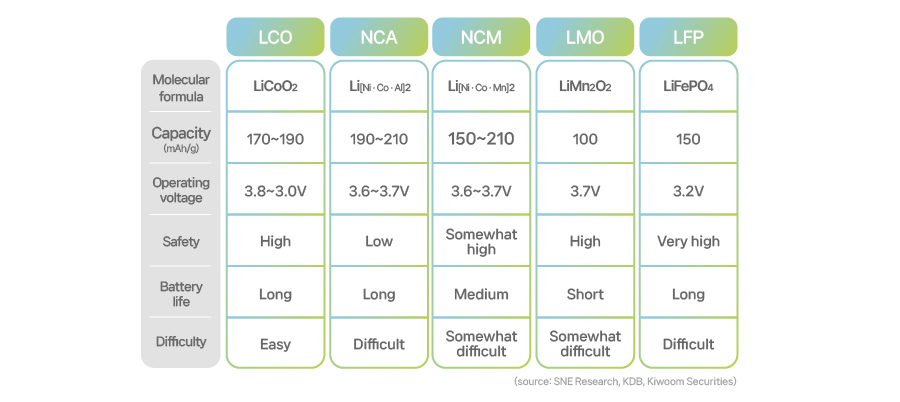
[Types and characteristics of cathode active materials in lithium-ion batteries]
Since LCO ushered in the era of lithium-ion batteries in 1990s, the technology has continued to evolve. Amid this trend, SAMSUNG SDI is strengthening its competitiveness by maintaining a diverse material portfolio to respond to varying market demands.
Ternary materials such as NCA and NCM feature increased energy density. SAMSUNG SDI applies its proprietary High-Ni technology, which maximizes nickel content, to NCA and NCM to achieve high capacity and power output.
Although LFP materials are at a disadvantage in energy density compared to ternary materials, their structure offers greater stability and cost competitiveness. These characteristics are attracting market attention for ESS applications that require large-scale deployment, and SAMSUNG SDI will adopt LFP prismatic batteries for “SBB(Samsung Battery Box) 2.0,” its single-unit ESS solution.
The reason SAMSUNG SDI utilizes diverse cathode materials is that use environments and customer needs differ. Matching the right strategy to right application is essential. For EVs that demand long range and high performance, ternary materials that deliver high capacity and power are the right fit, while for ESS where cost efficiency and stability are the priority, LFP materials are the better choice.
SAMSUNG SDI is committed to solidifying its market position by maintaining a broad material portfolio encompassing NCA, NCM, and LFP, and delivering tailored solutions to customers around the world.

SAMSUNG SDI Newsroom
We deliver the latest news and issues coming out of SAMSUNG SDI.