Technology & Products
[Battery Glossary] Cell Assembly, Winding, Z-Stacking
2026.04.14
|
[Battery Glossary] answers the questions related to batteries with key term explanation. From fundamental battery principles, manufacturing processes to emerging next-generation technologies, [Battery Glossary] makes battery concepts easy to understand. |
Cell Assembly
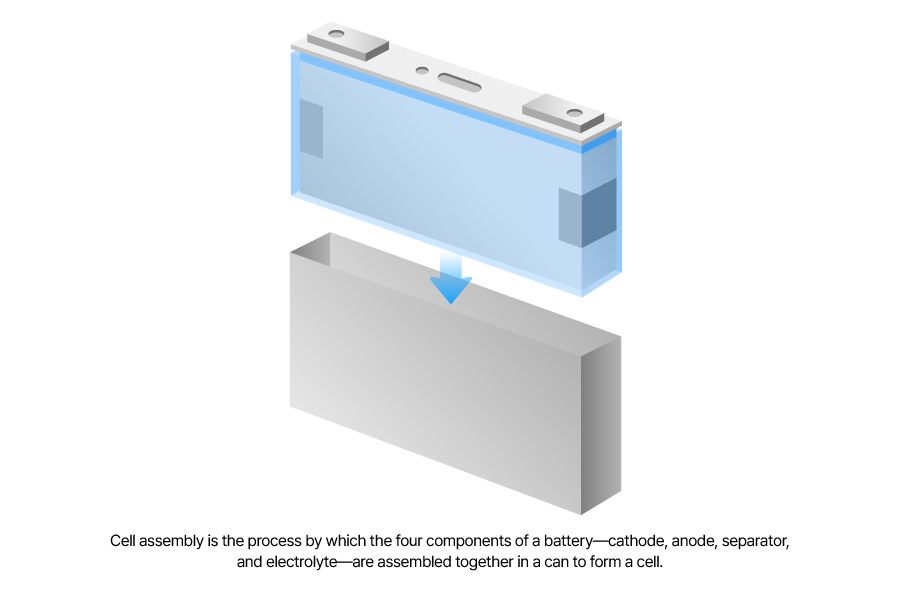
Cell assembly is the process by which the four components of a battery—cathode, anode, separator, and electrolyte—are assembled together in a can to form a cell.
Cell assembly is the process by which the four components of a battery - cathode, anode, separator, and electrolyte - are assembled together in a can to form a single cell. Cell assembly process consists of winding/Z-stacking, assembly and welding, and electrolyte injection.
First, a separator is placed between the cathode and anode and either wound together (winding) or stacked in a zigzag pattern (Z-stacking). Generally, the winding process is used to make cylindrical batteries while Z-stacking is used for prismatic batteries. The semi-finished product resulting from winding is known as a “jelly roll (J/R)” while the one produced by Z-stacking is called a “stack.”
Next, the jelly roll or stack is inserted into the can, followed by the assembly and welding of various components. Finally, the electrolyte is injected into the assembled can to complete the assembly process. The most critical part of this process is to ensure a perfect seal—preventing any foreign substances from entering the battery and ensuring that the injected electrolyte does not leak out.
Winding
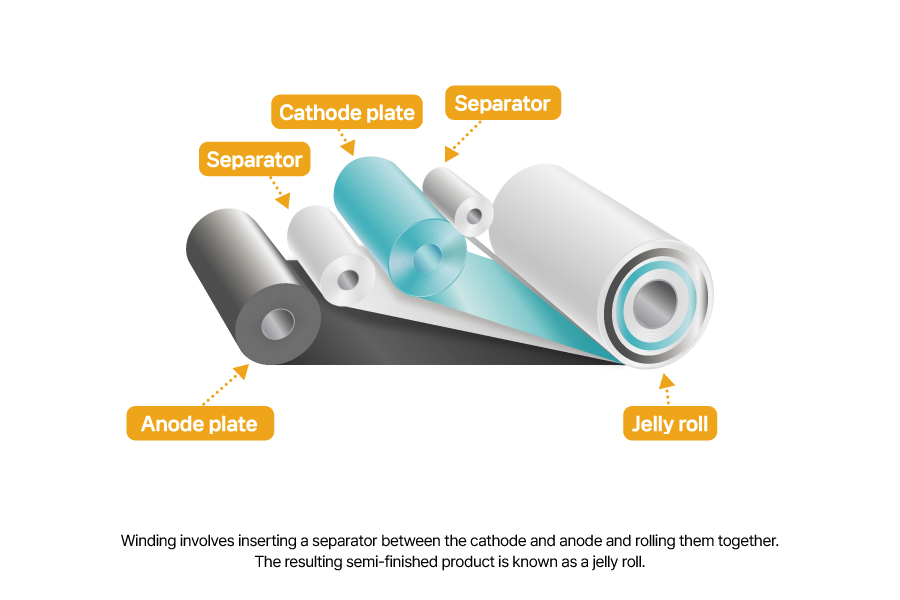
Winding involves inserting a separator between the cathode and anode and rolling them together, resembling the shape of a rolled-up paper towel. This method is predominantly used for manufacturing cylindrical batteries. The resulting semi-finished product is known as a “jelly roll (J/R)”. Ensuring precise alignment during winding is crucial, as misalignment can lead to internal short circuits.
Z-Stacking
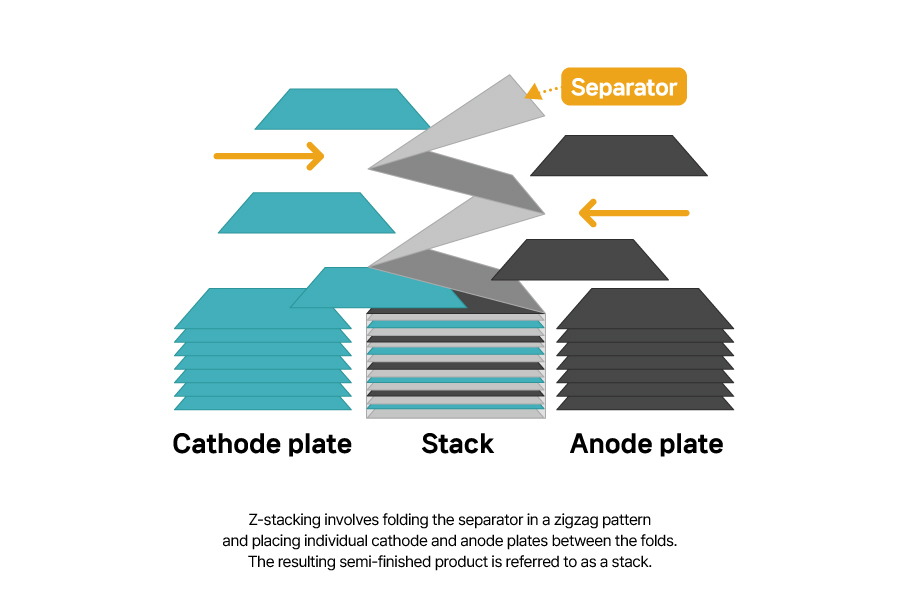
Z-stacking involves folding the separator in a zigzag pattern and placing individual cathode and anode plates between the folds. This technique is commonly applied in the production of prismatic batteries.
The semi-finished product from Z-stacking is referred to as a “stack.” Compared to winding, Z-stacking allows for better utilization of space within the battery casing, enabling higher capacity batteries.

SAMSUNG SDI Newsroom
We deliver the latest news and issues coming out of SAMSUNG SDI.