Technology & Products
[Battery Talk Talk] Key Characteristics of Power, Capacity, and Energy Density
2026.04.09
|
[Battery Talk Talk] From simple curiosities to insight-driven questions, let’s walk through “all about battery” briefly. |
When you read news or information about batteries, you often see various units such as Ah(ampere-hours) and Wh(watt-hours). They indicate battery performance metrics like power output, capacity, and energy density. In this article, we examine these core performance indicators and their respective units of measurement.
Power (Watts, W): The instantaneous force
Power refers to the amount of energy a battery can deliver per unit of time. It is measured in W(watts) and is calculated by multiplying voltage by current. This means that higher voltage and current result in a greater amount of electrical energy the battery can provide.
|
Power(W) = Voltage(V) X Amperage(A) |
A battery with high power can deliver more force per unit of time. Therefore, it demonstrates its prowess in applications that require instantaneous bursts of energy.
To secure high power performance, SAMSUNG SDI developed Tabless technology and applies it to BBU and cylindrical batteries for power tools.
High-power characteristics are increasingly drawing attention in the EV and ESS sectors, as higher output is conducive to fast charging and sudden acceleration in EVs, and to managing power peaks in ESS.
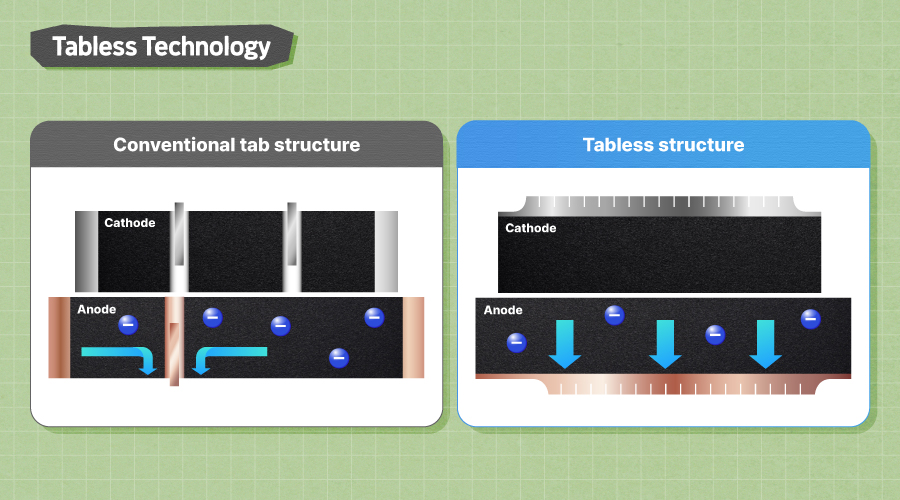
[Tabless technology of SAMSUNG SDI maximizes the high power characteristics of cylindrical batteries.]
Energy stored in a battery (Watt-hours, Wh)
The total amount of energy that a battery can store and provide is represented in Wh(watt-hours) and is commonly referred to as energy. Energy is calculated by multiplying voltage, current, and usage time. In other words, it is a performance indicator showing how much work a battery can perform over a specific period.
|
Energy(Wh) = Voltage(V) X Amperage(A) X Time(hours) = Voltage(V) X Capacity(Ah) |
The key factor determining energy is capacity. Measured in Ah(ampere-hours), capacity is the product of current and usage time, representing the amount of charge a battery can store. For batteries with the same voltage, higher capacity leads to greater energy. Additionally, since capacity is closely related to the lifespan and safety of the battery, it stands as a critical benchmark in battery system design.
Capacity is determined by the type and amount of cathode active materials. To achieve high-capacity properties, SAMSUNG SDI developed cathode materials such as high-nickel NCA (Nickel, Cobalt, Aluminum) with over 90% nickel content, and is utilizing them in cylindrical and prismatic batteries.
Energy density (Watt-hours per liter, Wh/L): Energy per unit space
You may recall that SAMSUNG SDI’s 700Wh/L prismatic battery won the “InterBattery 2026” awards. The unit “Wh/L(Watt-hours per liter)” represents energy density.

[SAMSUNG SDI’s prismatic battery with high energy density was awarded at the InterBattery 2026.]
Energy density refers to the amount of energy that can be stored per unit volume or weight, indicating the efficiency of a battery’s design.
|
Energy density(Wh/L) = Energy(Wh) ÷ Volume(L) Energy density(Wh/kg) = Energy(Wh) ÷ Weight(kg) |
A battery with high energy density can store more energy within the same weight or volume, enabling longer use on a single charge. It also facilitates weight reduction and downsizing. By using high-energy-density batteries, you can extend the driving range of EVs and use them efficiently in limited spaces, such as ESS and UPS system.
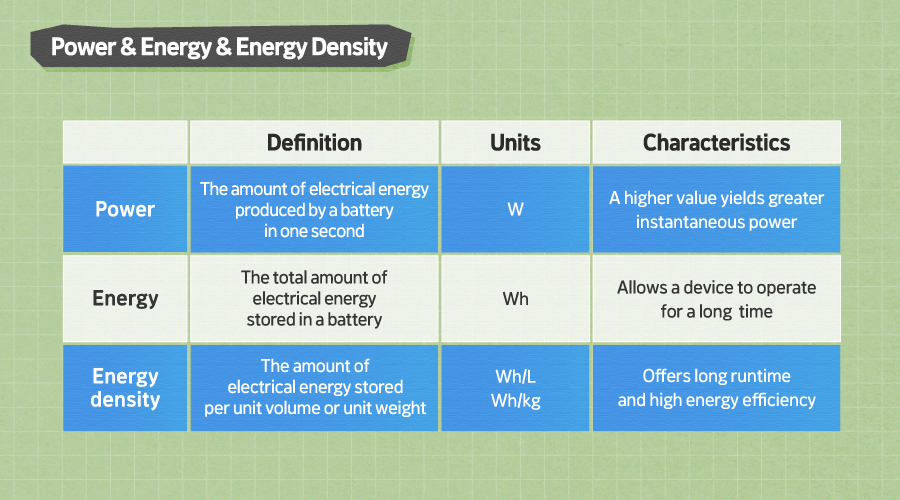
[Indicators of battery performance]
As we have seen, battery performance can be understood through these various indicators. [Battery Talk Talk] will be back with another insightful topic!

SAMSUNG SDI Newsroom
We deliver the latest news and issues coming out of SAMSUNG SDI.