Technology & Products
[BoT] Distributed Power Grids and Batteries for ESS
2026.04.02
|
The era of ‘BoT (Battery of Things)’—where batteries become the core of everything around us—is drawing near. From robots and IT devices to electric vehicles, batteries already serve as the driving force behind countless machines. Here, we look at the battery characteristics for each application and SAMSUNG SDI’s leading technologies. |
As the growing number of AI datacenters sharply raises the demand for power, the distributed grid and its core infrastructure, Energy Storage Systems(ESS), are drawing attention. These systems can ease the burden on the electricity network and increase the energy self-sufficiency of local regions.
A distributed grid is a next-generation system that connects small-scale power sources, primarily renewable energy, to the network. The generated electricity is either connected to the existing grid to meet demand or linked to *microgrids, enabling power generation and consumption within specific areas.
*Microgrid: A self-controlled system capable of generating and consuming power within a specific region
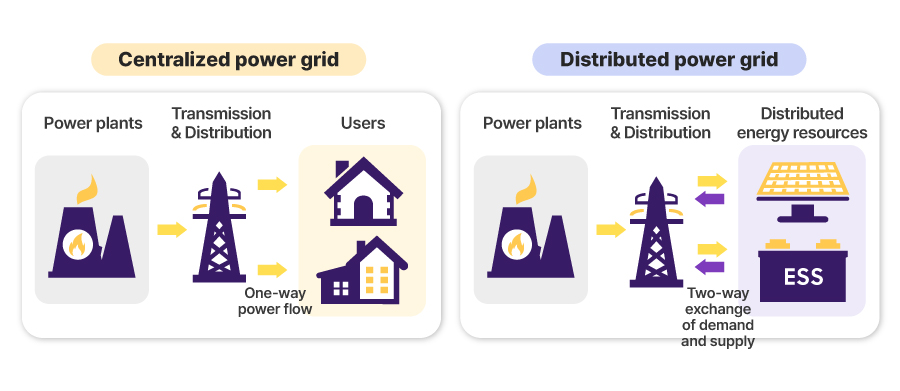
[Unlike centralized systems where power moves one-way,
a distributed grid operates with a bi-directional structure where power is stored and supplied on demand.]
ESS plays a critical role in ensuring the stability of the distributed grid. By adopting ESS, the volatility of power generation from renewable sources (which fluctuates by time, weather, and season) is effectively alleviated. When generation is limited by environmental factors, the power stored in ESS can be supplied to the network or a microgrid.
Compared to building new power networks, ESS requires less installation time and cost, allowing the distributed grid to be established more efficiently. Given these advantages, the government is leading large-scale of ESS bidding projects, while various renewable energy initiatives are moving forward overseas.
SAMSUNG SDI has introduced SBB(Samsung Battery Box), a single integrated battery solution that allows customers to easily install and use ESS. Since SBB incorporates all components, including battery cells, modules, and racks, into a 20-foot container, a simple connection to the network makes it ready for immediate use. Moreover, the company offers a wide range of products, such as SBB 1.5 and SBB 1.7 adopting NCA(Nickel, Cobalt, Aluminum) battery cells, and SBB 2.0 with LFP(Lithium, Iron, Phosphate) battery cells, to meet diverse customer demands.
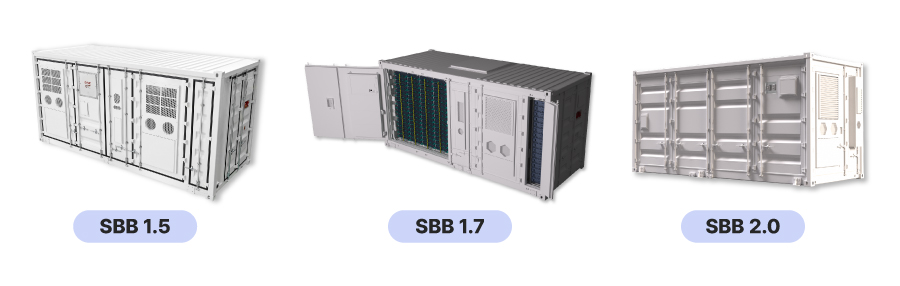
[SAMSUNG SDI's SBB(Samsung Battery Box) line-up]
The most notable advantage of SBB is its safety. SBB includes No TP(No-Thermal Propagation) and EDI(Enhanced Direct Injection) technologies, which are proprietary solutions to prevent thermal propagation. It also integrates SBI(Samsung Battery Intelligence), a software designed to prevent fire. This enhanced safety allows SBB to diagnose batteries using AI to detect and predict potential errors.
Going forward, SAMSUNG SDI will continue to offer optimal battery solutions for ESS that meet customer demand through best-in-class technologies.

SAMSUNG SDI Newsroom
We deliver the latest news and issues coming out of SAMSUNG SDI.