Technology & Products
[SDI Today] KRW 1.4 Trillion R&D Investment Spurs Stronger Tech Competitiveness
2026.03.31
As technology competition across the battery landscape intensifies, SAMSUNG SDI is steadily expanding its R&D investments to take the lead in the future market. Behind this large-scale investment is a growth strategy focused on technological competitiveness.
SAMSUNG SDI’s total R&D spending as of 2025 stands at KRW 1.4209 trillion. This marks a 9.5% increase from KRW 1.2975 trillion the previous year. The ratio of R&D spending to revenue also rose from 7.8% in 2024 to 10.7% in 2025, indicating continued investment at a relatively high level compared to its revenue scale.
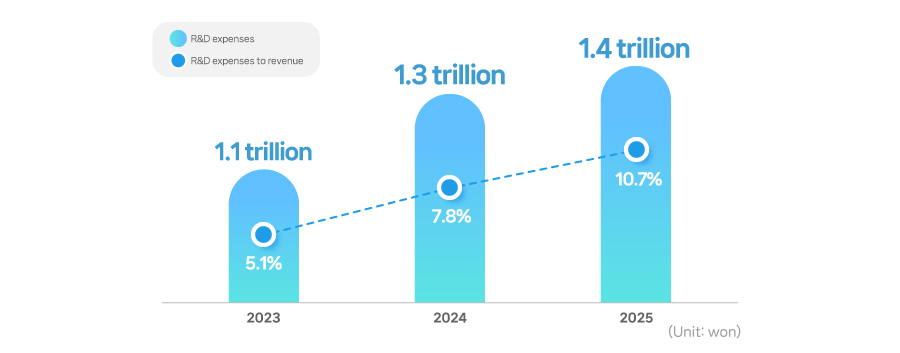
[R&D expenses and its ratio to revenue over the last three years]
Since technological capability has emerged as a key factor in determining competitiveness in the global battery market, SAMSUNG SDI continues to position itself to lead in securing advanced technologies through incremental R&D investment.
More specifically, the number of patents for prismatic batteries in the U.S. stood at around 1,200 as of 2025, pointing to a steady buildup of technological know-how and IP rights in prismatic battery design and the manufacturing processes. The company now refers to these technologies as “PrismStack” and continues to strengthen its technological foothold.
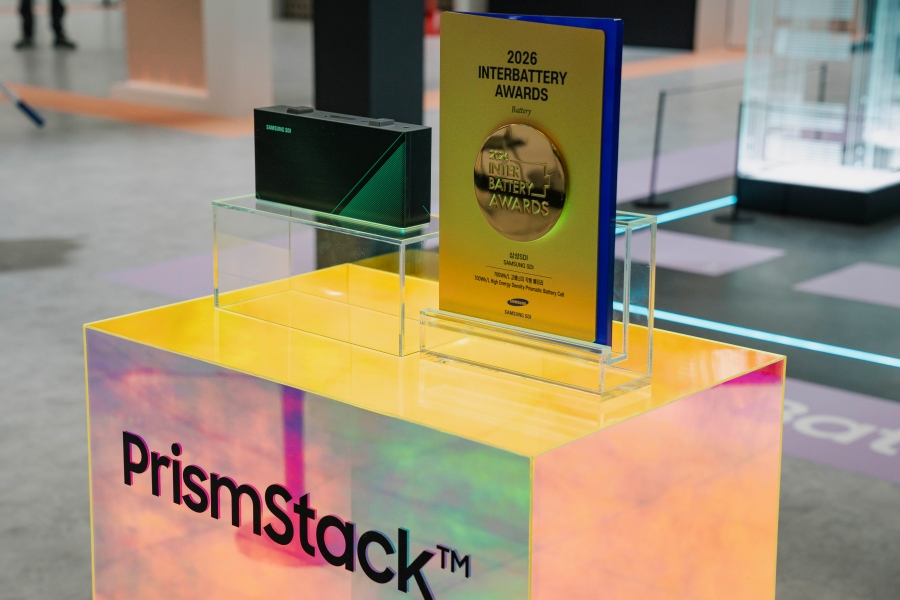
[“PrismStack”, a new name of SAMSUNG SDI’s prismatic battery, was unveiled at InterBattery 2026]
It also established the “Electrode Center” in July 2025 as part of its efforts to enhance technological capability. As electrodes play a critical role in determining the quality and performance of battery cells, the electrode center conducts R&D across the entire spectrum, from process development to mass production. Through these efforts, SAMSUNG SDI aims to further improve battery performance and ensure quality stability.
Along with this, SAMSUNG SDI has begun referring to its all-solid-state batteries as “SolidStack.” These batteries are now gaining traction as next-generation batteries, and the company is accelerating development with the goal of mass production in the second half of 2027. All-solid-state batteries are expected to outperform conventional batteries in safety and energy density by adopting solid electrolyte. They are widely recognized as a paradigm-shifting technology in the battery market. SAMSUNG SDI notably holds strong technological competitiveness, with around 1,100 patents related to all-solid-state batteries. It has also diversified its all-solid-state battery portfolio, offering a prismatic form factor for EVs, where safety is critical, as well as a lightweight pouch-type for physical AI.
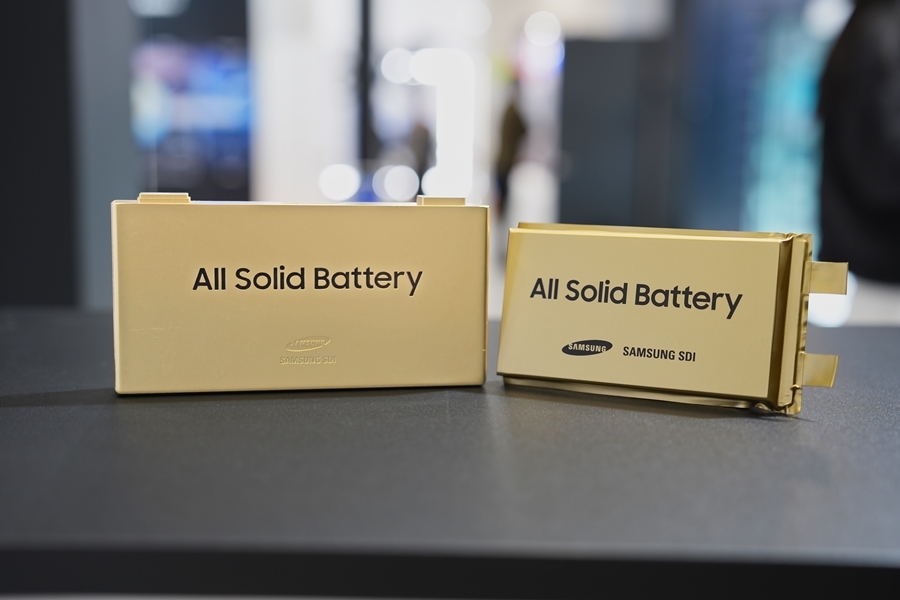
[SAMSUNG SDI’s all-solid-state battery lineup]
It also goes beyond the battery sector and continues to accumulate R&D achievements in electronic materials, including foldable displays and high-thermal-conductivity packaging materials for semiconductors. Through this, it is expanding its technology portfolio.
FOCA(Flexible Optical Clear Adhesive), a material for foldable displays, enhances adhesion compared to conventional OCA. This enables the required properties for foldable devices.
Moreover, as semiconductors continue to advance in performance in the AI era, the development of EMC(Epoxy Molding Compound) with significantly improved thermal management is underway to effectively dissipate internal heat.
SAMSUNG SDI plans to further advance its technological maturity through continued R&D investments. It also aims to solidify mid- to long- term growth foundation centered on next-generation technologies. This strategy is expected to strengthen its technological competitiveness in global market and reinforce its leading position in both the battery and electronic materials market.

SAMSUNG SDI Newsroom
We deliver the latest news and issues coming out of SAMSUNG SDI.