People & Culture
[SDI Interview] Interview with SAMSUNG SDI Researchers: Collaboration Between Academia and Industry Improves Lithium Metal Battery’s Life and Safety
2026.02.23
Research on lithium metal batteries conducted through an industry-academia cooperation between SAMSUNG SDI and Columbia University was published in Joule, a prestigious journal in the energy field. Joule is a sister journal to Cell, one of the top three academic journals, and it at the peak of the energy sector.
The research holds significant weight as it proposes methods to enhance the lifespan and safety of lithium metal batteries, which are gaining attention as new-generation batteries. We met Hyunsik Woo from SAMSUNG SDI research center, along with Yang Li and Yuanyuan Ma from SDIRA, to discuss the research background, their cooperation, and technological significance of the findings.
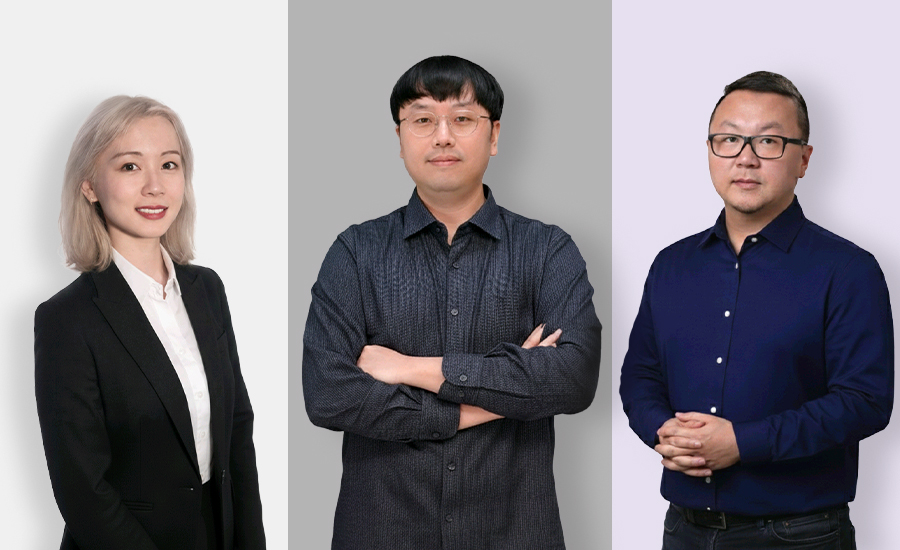
[(From left) Yuanyuan Ma of SDIRA, Hyunsik Woo of Research Center, Yang Li of SDIRA, who led the industry-academia collaboration project]
Q. Could you explain the background behind initiating this industry-academia project?
Hyunsik Woo) SAMSUNG SDI is researching a variety of next-generation battery technologies to overcome current limitations in energy density, lifespan, and safety. As part of this effort, we are conducting R&D to develop lithium metal battery technology that can significantly enhance volumetric energy density.
Lithium metal batteries offer high energy density and can utilize existing lithium ion battery processes. However, they face limitations regarding lifespan and safety, requiring new technologies to overcome these challenges.
To address these challenges, SAMSUNG SDI pursued industry-academia collaboration projects with leading overseas institutions. This led to significant achievements through our cooperation with SDIRA, which was established in Boston in 2022.
|
Key takeaways of the paper This paper presents research on developing and applying a gel polymer-type electrolyte instead of the commonly used liquid electrolyte to overcome the limitations of lithium metal batteries. This novel semi-solid electrolyte stabilizes the interface between the electrode and electrolyte, improving lifespan characteristics and enhancing safety by preventing internal short circuits. |
Q. During the joint research, what specific role did the SAMSUNG SDI researchers play?
Hyunsik Woo) SAMSUNG SDI research center proposed the fundamental research design and evaluation conditions, while providing battery materials that embody SAMSUNG SDI’s technologies. We collaborated by being as open as possible, excluding SAMSUNG SDI’s most sensitive core technologies. We specifically focused on providing feedback on monthly reports generated by Columbia University. This close partnership played a crucial role in achieving the research outcomes.
Yang Li) SDIRA actively communicated with Columbia University, which conducts industrial-academia projects, translating the strategic goals set by HQ into specific research projects. We also played a major role in proving the electrolyte mechanism presented in the paper. This was achieved by repeatedly verifying experiments using SDIRA’s infrastructure, which enables rapid experimental design and validation.
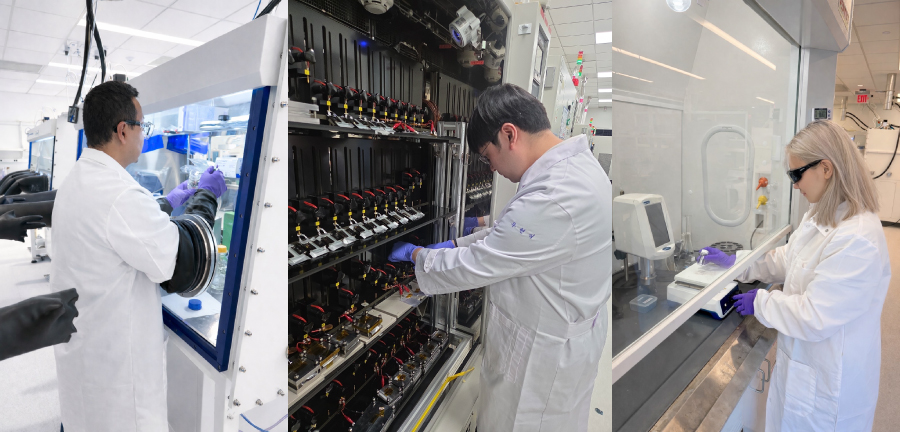
[(From left) Yang Li, Hyunsik Woo, and Yuanyuan Ma conduct experiments]
Q. During the research, what was the most challenging aspect and how did you address it?
Yuanyuan Ma) Synchronizing the different research environments was one of the most challenging tasks. The results from Columbia University had to be consistently replicated at SDIRA, and remain applicable even under the strict testing conditions of industrial settings. To address this, we organized data-sharing sessions where the three institutions coordinated to ensure the research always moved in the same direction.
Q. Please share your thoughts on future research directions and your mindset moving forward.
Hyunsik Woo) It remains uncertain which technology will emerge as the definitive next-generation battery following lithium ion. Lithium metal batteries are a strong candidate, but numerous challenges still need to be addressed. I will dedicate myself to overcoming these hurdles to enhance the competitiveness of next-generation battery technology. This commitment will enable SAMSUNG SDI to lead the future battery market.
Yang Li) In next-generation battery research, I believe the key challenge is simultaneously enhancing energy density and safety. We plan to prioritize meeting the performance and safety requirements of customers while maintaining our curiosity about future technologies, continuously exploring and advancing our research.
|
Interview with Professor Yuan Yang of the Columbia University, an industry-academia cooperation partner Cooperation with SAMSUNG SDI ensured scientific rigor and industrial applicability in lithium metal battery research. SAMSUNG SDI provided concrete guidance reflecting real industry environments, such as material ratios and safety standards. This enabled us to conduct research under on-site cell conditions rather than idealized lab settings. Industry-academia cooperation plays a crucial role in driving academic discoveries toward commercialization. This partnership with SAMSUNG SDI served as a catalyst for lithium metal battery technology to take a significant leap forward. |

SAMSUNG SDI Newsroom
We deliver the latest news and issues coming out of SAMSUNG SDI.