Technology & Products
[SDI Focus] The Key to Battery Performance and Safety: Electrode
2026.02.13
Electrodes are gaining attention as the key factor determining battery performance and safety. An electrode stores lithium ions and serve as a pathway for electron movement. The battery’s capacity, charging speed, and other performance characteristics are dictated by how many lithium ions the electrode can store and how quickly electrons can move. Ultimately, it’s no exaggeration to say that battery performance hinges on the design and manufacturing process of the electrode.
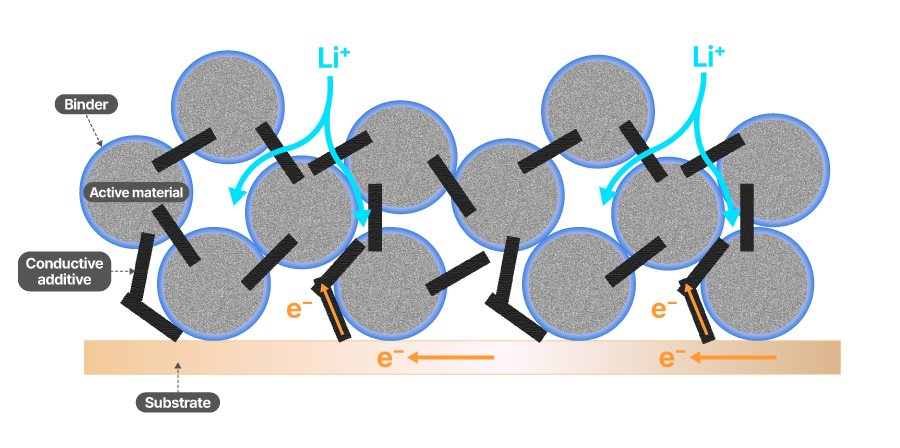
[The electrode structure consists of a slurry layer made of a mixture of active material, conductive additives, and binder, along with the substrate.]
A closer look at the electrode structure reveals why. The electrodes consist of a slurry layer made up of active material, binder, and conductive additives, and a substrate that supports this layer while transferring electrons. When designing an electrode, both the selection of specific materials for the slurry and the precise ratio between them are critical. These factors, along with the thickness of the slurry layer deposited on the substrate, and the type of substrate are carefully adjusted based on the battery’s final specifications.
To increase battery capacity, for instance, designing a thicker slurry layer is often preferred. This is because a larger volume of active material in the slurry can hold more lithium ions. However, a thicker layer also increases the migration path for ions between the anode and cathode, which slows down charging speeds. Additionally, thicker slurry layers are more challenging to handle during the manufacturing process.
Another way to boost capacity is to increase the density of active material. This involves packing more active material into the same amount of space. However, if the active material is packed too tightly beyond a certain limit, the slurry layer can fracture.
Ultimately, to develop products delivering the performance and quality required by customers, it is essential to design electrodes by thoroughly considering conflicting factors and to advance process technologies for these challenges.
Recently, SAMSUNG SDI has been focusing on LFP-based electrode design and securing process technologies. With the rapid expansion of AI data centers driving a surge in power consumption, the importance of ESS to meet the increased demand is growing significantly. Accordingly, demand for cost-competitive LFP batteries is also expanding rapidly.
Compared to traditional ternary materials, LFP active materials have smaller particle sizes, making it difficult to disperse them evenly within the slurry. They also require a higher volume of solvent, which complicates the drying process. While increasing drying speeds might seem like a solution, doing so can negatively impact productivity and price competitiveness and this calls for better solutions.
To improve productivity and quality, SAMSUNG SDI is focusing on developing new dispersants and binders, and securing electrode coating and drying process technologies.
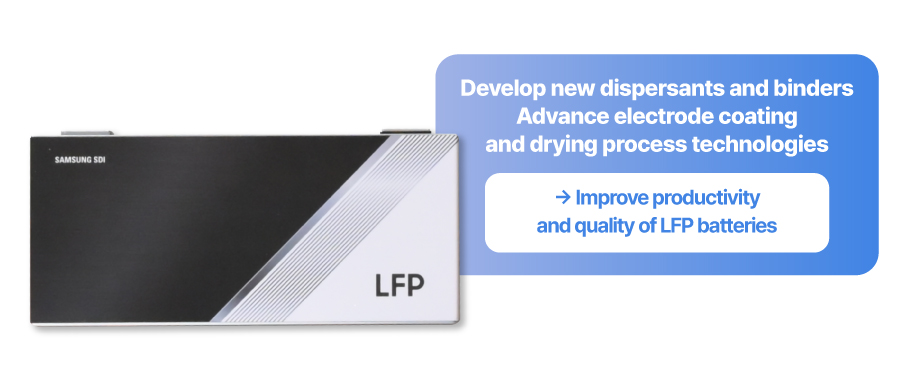
[SAMSUNG SDI is developing materials and advancing process technologies to improve productivity and quality of LFP batteries.]
SAMSUNG SDI is committed to proactively meeting customer and market demands by developing optimal electrode structures tailored to material properties and continuously advancing its manufacturing technologies.

SAMSUNG SDI Newsroom
We deliver the latest news and issues coming out of SAMSUNG SDI.