Technology & Products
[Battery Talk Talk] Battery Form Factors, Are They Different Only in Shape?
2026.02.11
|
The form factor refers to the physical specifications and shape of a hardware product. The battery form factors are commonly categorized into cylindrical, prismatic, and pouch cells. But are they only different in shape? |
Before we walk through the different features of the batteries, there is a reason why they come in different shapes.
The applications of batteries are various. From small wearable devices and smartphones to massive equipment such as EV and ESS, batteries are utilized in many fields. Their physical specifications, including size, weight, along with performance, are different depending on the applications. Consequently, battery makers produce three different form factors to address these needs: cylindrical, prismatic, and pouch cells.
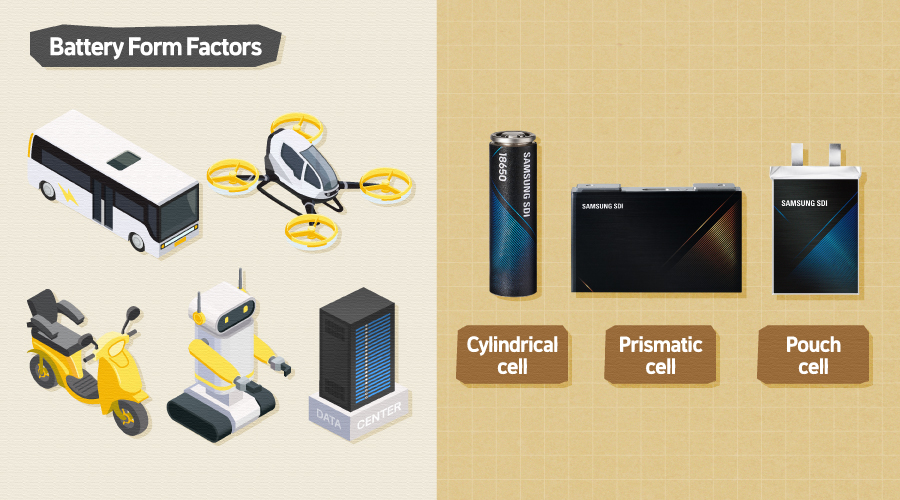
[There are three common battery form factors.]
Do you now understand that there are different battery form factors designed to optimally deliver power based on the device? If so, let us take a look at the features of each form factor.
As the name suggests, cylindrical cells have a metallic cylindrical casing, making them small and lightweight. Inside the metal casing, there are a cathode and anode, rolled up like toilet paper, along with a separator. This structure is called a “Jelly roll.” A winding process that makes this jelly roll configuration enables high-speed production of the battery, giving it an advantage in terms of price competitiveness.
Because the electrode sheets are rolled up, the surface area is large relative to the cell’s volume, making it advantageous for high capacity and high-power output. SAMSUNG SDI even enhanced the high-power performance of cylindrical cells by applying its Tabless technology*.
*Tabless technology: The technology replaces traditional tabs with the electrode itself as a pathway for electron flow, reducing internal cell resistance and enabling high-power output.
Therefore, cylindrical cells are suitable for small applications that require high capacity and high-power output. They are commonly utilized in power tools and garden tools. For applications needing to be small and lightweight while delivering instantaneous high power, cylindrical cells come ahead of others.
We are also seeing the spotlight on cylindrical cells in robotics recently. This is because while the space for the battery is limited, the application requires high capacity. Specifically, cylindrical cells utilizing High-Nickel NCA materials are evaluated as the best solution for robot batteries, as they feature both space efficiency and high energy density.
* Link: [BoT] Batteries for All Applications, Robots
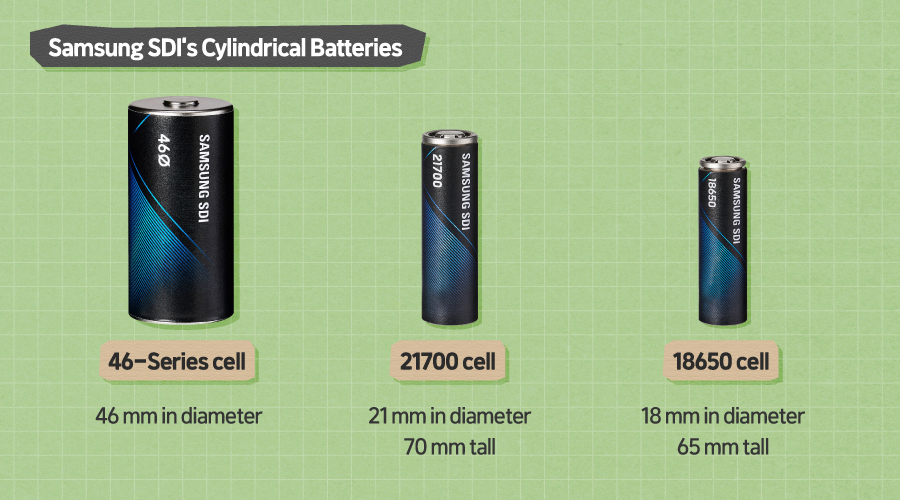
[SAMSUNG SDI is responding to different needs through its cylindrical battery portfolio.]
Prismatic cells are rectangular cells with an aluminum casing. Their most distinctive feature is outstanding safety. The rigid aluminum case provides superior resistance to external shock. Especially, SAMSUNG SDI’s prismatic cells apply NO TP(No Thermal Propagation) Technology which prevents heat propagation to maximize safety.
The prismatic cells are suitable for applications requiring a lot of energy. The form factor itself is the largest among the others and easily allows adapting the cell size to capacity requirements. The rectangular shape also offers space-efficiency advantages when placing multiple cells for high capacity.
These features make prismatic cells primarily used in EV and ESS where high capacity, high energy density, and safety are required.
* Link: [SDI Focus] No TP Enhances Battery Safety by Preventing Thermal Propagation
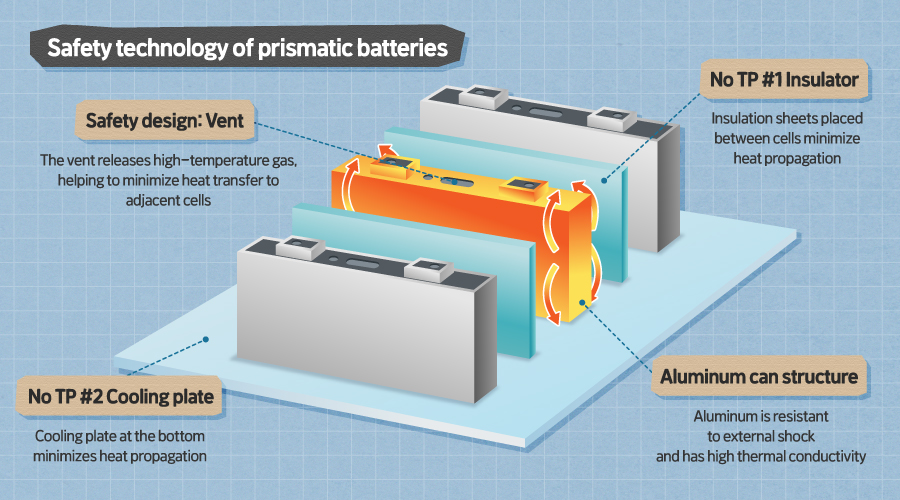
[SAMSUNG SDI’s prismatic cells utilize many technologies to ensure safety.]
Pouch cells present a design where a thin film is sealing the cathode, anode, and separator. Their greatest advantage is light weight and their flexibility to adapt to any shape.
These characteristics make pouch cells the primary choice for IT devices such as wearables and smartphones. Since small IT devices have irregular battery space with no defined shape, pouch cells, which are easy to form, are advantageous.
Moreover, power usage is continuously increasing as smartphones become much thinner and integrated with high performance like AI. In response to the market needs, SAMSUNG SDI is focusing on developing technologies that increase pouch cell capacity.
* Link: [Battery101] Pouch Batteries Come in Different Sizes and Shapes
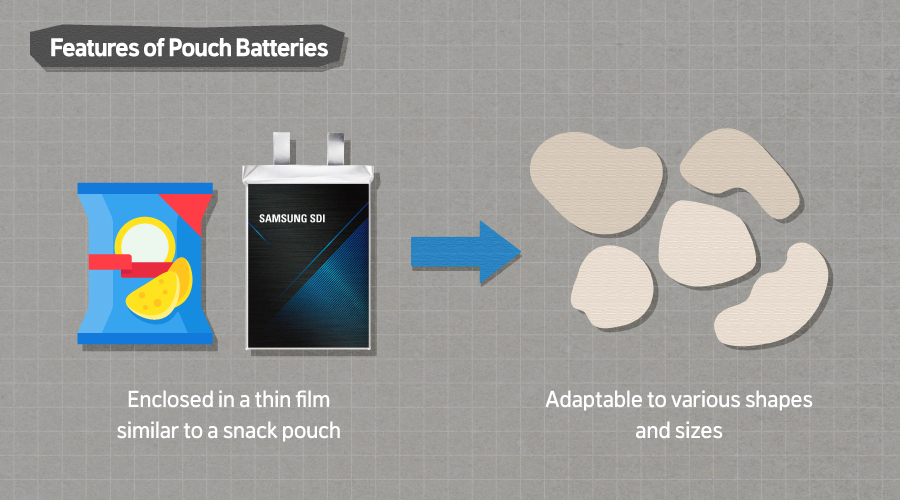
[Pouch cells hold superiority in that they can be freely processed into desired shapes, enabling battery integration into irregular spaces.]
The three distinct form factors aren’t just different in shape. They each have different features and applications. The [Battery Talk Talk] will come back with even more interesting and insightful topics in the next episode.

SAMSUNG SDI Newsroom
We deliver the latest news and issues coming out of SAMSUNG SDI.