Technology & Products
[SDI focus] Low-Resistance Technology: Enhancing the Battery Performance
2025.09.25
Fast charging has always been a key focus in the battery market, as it is a critical factor in enhancing the convenience of EV drivers. Charging speed depends on the mobility of lithium ions. Therefore, reducing the ‘resistance’ that hinders the movement of lithium ions inside the battery cell is essential, which makes low-resistance the core of fast charging.
A battery cell is an embodiment of highly sophisticated technologies. In addition to the four key materials—cathode, anode, separator, and electrolyte—it also contains components that enable current flow and ensure safety. While all of these materials and components are essential, for lithium ions they represent obstacles and resistance that hinder the movement of lithium ions.
Such internal resistance can affect not only charging speed but also output and lifespan of a battery. To enhance battery performance, SAMSUNG SDI is applying low-resistance technology from materials to components.
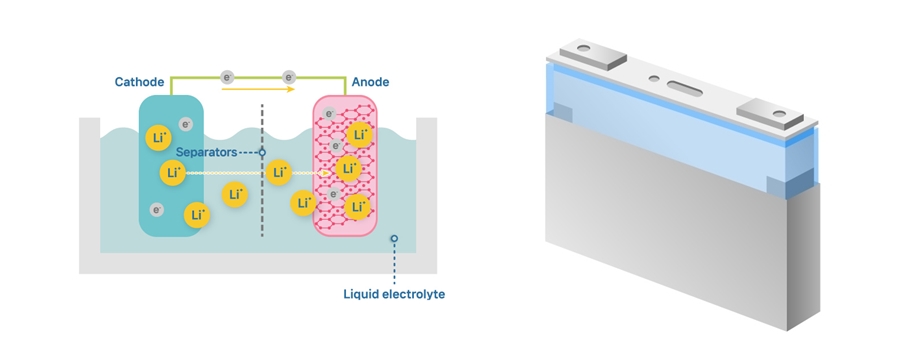
[The four key materials (cathode, anode, separator, electrolyte) and
other components inside the battery serve as resistances to Li-ion movement]
In terms of materials, low-resistance technology is applied to anode, electrolyte and binder.
SAMSUNG SDI’s anode material, SCN (Si-Carbon-Nanocomposite), reduces interfacial resistance by uniformly coating the surface of nano-sized particles. Interfacial resistance refers to the resistance that occurs at the surface where different materials meet. When lithium ions move between the cathode and anode, SCN enhances fast charging by lowering the interfacial resistance on the anode.
Electrolytes also play a crucial role, helping lithium ions move between the cathode and anode. By designing electrolytes with high conductivity*, lithium ions can move more quickly.
* High conductivity : High conductivity means low internal resistance, affecting the movement lithium ions.
On top of that, low-resistance technology is also being applied to the binder material used in the anode. The binder helps active materials adhere firmly to the electrode. Recently, low-resistance designs utilizing the hopping* effect have been introduced to facilitate lithium ion movement within the anode, thereby improving charging speed.
* Hopping : a phenomenon in which particles move by jumping between atoms or molecules within a material.
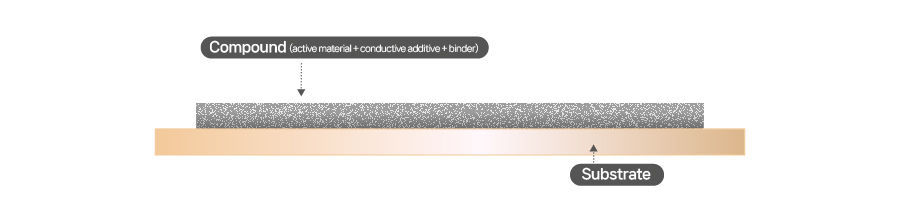
[Battery electrodes are made of slurry and a metal substrate.
Applying low-resistance technology to the active materials and binders in slurry improves performance]
Efforts to reduce resistance are also continuing when it comes to component. In particular, by efficiently integrating the functions of existing internal components, performance has been improved while reducing the number of parts, which allows current to flow more quickly.
Low-resistance technology applied to materials and components can enhance not only charging speed but also the output and lifespan of batteries. SAMSUNG SDI will continue to advance this technology to deliver batteries that meet market expectations.

SAMSUNG SDI Newsroom
We deliver the latest news and issues coming out of SAMSUNG SDI.