Technology & Products
[Battery Glossary] Li-ion Battery, Cathode Active Materials, Lithium, Precursor
2025.08.28
|
[Battery Glossary] answers the questions related to batteries with key term explanation. From fundamental battery principles, manufacturing processes to emerging next-generation technologies, [Battery Glossary] makes battery concepts easy to understand. |
Lithium-ion Battery
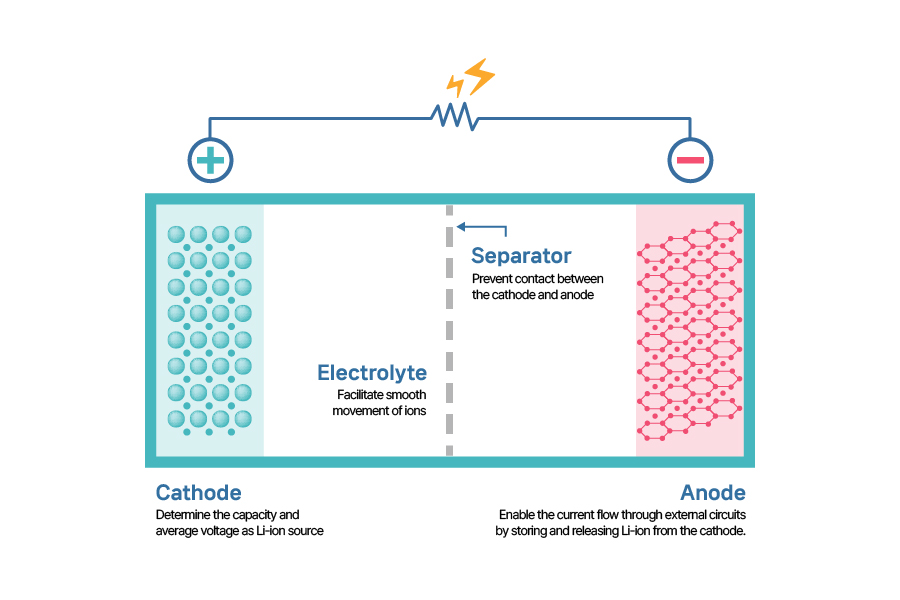
A lithium-ion battery is a representative type of secondary battery that uses lithium as its key material. It consists of a cathode, an anode, a separator, and an electrotype. Electricity is generated as electrons move between the cathode and anode through an external circuit. Lithium-ion batteries are generally classified based on the type of active materials used in the cathode. Common cathode active materials are metal oxides combined with lithium. These include LCO, NCA, NCM, NCMA and LFP.
Cathode Active Materials
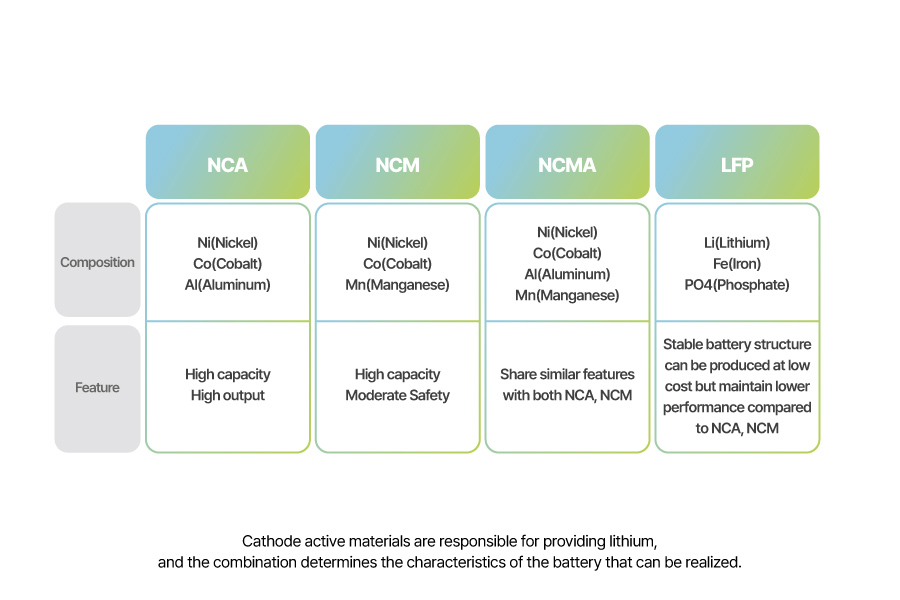
Cathode active materials refer to substances that provide lithium in the cathode and determine the battery’s capacity and voltage. Generally, cathode active materials of lithium-ion batteries are synthesized by combining lithium with various metal oxides.
Some commonly used metal oxide combinations include NCA (Nickel-Cobalt-Aluminum), NCM (Nickel-Cobalt-Manganese), NCMA (Nickel-Cobalt-Manganese-Aluminum), and LFP (Lithium-Iron-Phosphate). Each combination exhibits different battery characteristics, and battery manufacturers select cathode materials based on customer requirements and desired performance.
Lithium
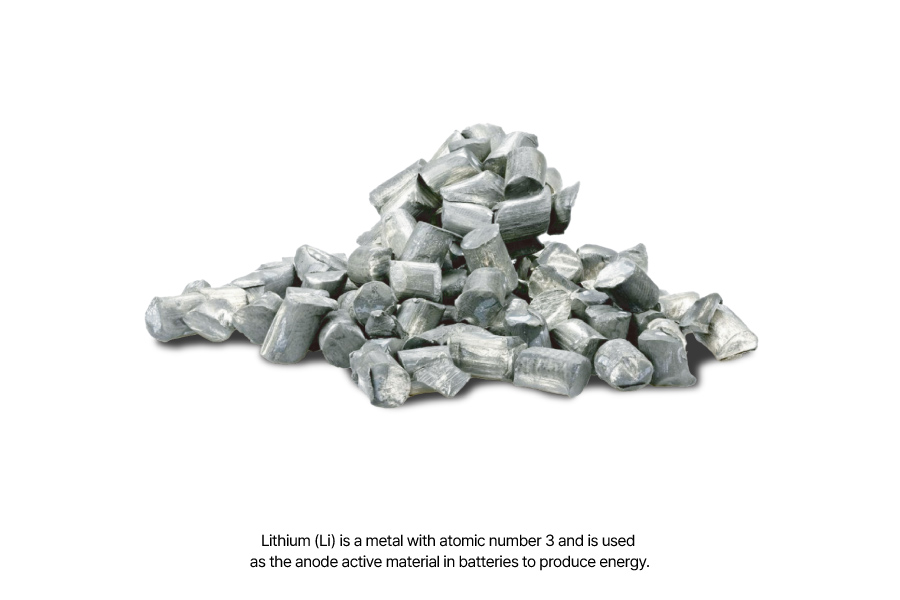
Lithium (Li) is one of the key components of the cathode active material in lithium-ion batteries. Within the battery, lithium-ion move between the cathode and anode, facilitating energy storage and release. The amount of lithium directly determines its capacity and voltage.
Since lithium has a structure that makes it highly reactive and prone to losing electrons, it is not used in its pure form for energy storage. Instead, stable lithium-metal oxides such as NCA, NCM and LFP are used as cathode active materials.
Precursor
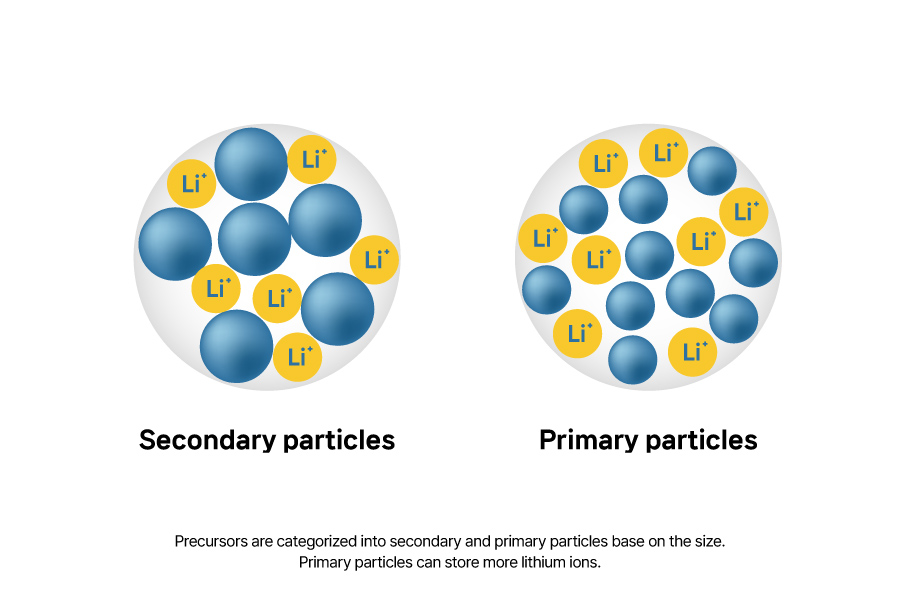
Precursor is a chemical compound that exists in an intermediate stage before a final material is synthesized. In lithium-ion batteries, the precursor refers to the compound formed before lithium is mixed into the cathode active material.
Precursors are categorized based on the size. The size of secondary particles is 10-20μm and primary particles are sized below 5μm. Recently, primary particles have gained attention because they can store more lithium ions, thereby increasing energy density. However, producing primary particles is complex and costly, so battery manufacturers often mix secondary and primary particles when producing cathode active materials.

SAMSUNG SDI Newsroom
We deliver the latest news and issues coming out of SAMSUNG SDI.