Technology & Products
[Battery Glossary] BMS, PCS, EMS
2025.07.24
|
[Battery Glossary] answers the questions related to batteries with key term explanation. From fundamental battery principles, manufacturing processes to emerging next-generation technologies, [Battery Glossary] makes battery concepts easy to understand. |
BMS (Battery Management System)
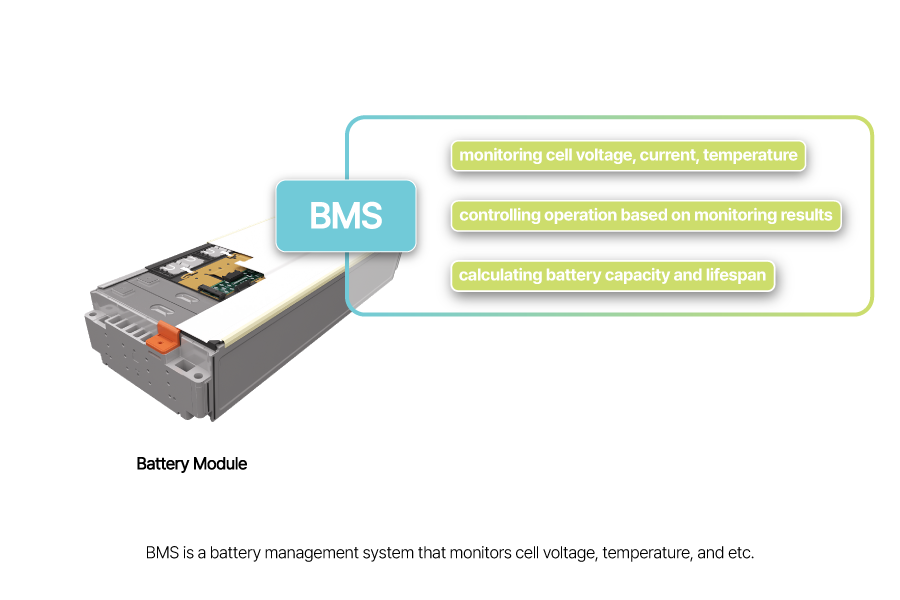
BMS (Battery Management System) is responsible for monitoring and controlling battery performance to ensure stable operation and efficient capacity management. It consists of both software and a circuit board. BMS is typically installed at the battery module level or higher and performs various functions such as monitoring cell voltage, current, and temperature, controlling operation based on monitoring results and calculating battery capacity and lifespan.
PCS (Power Conversion System)
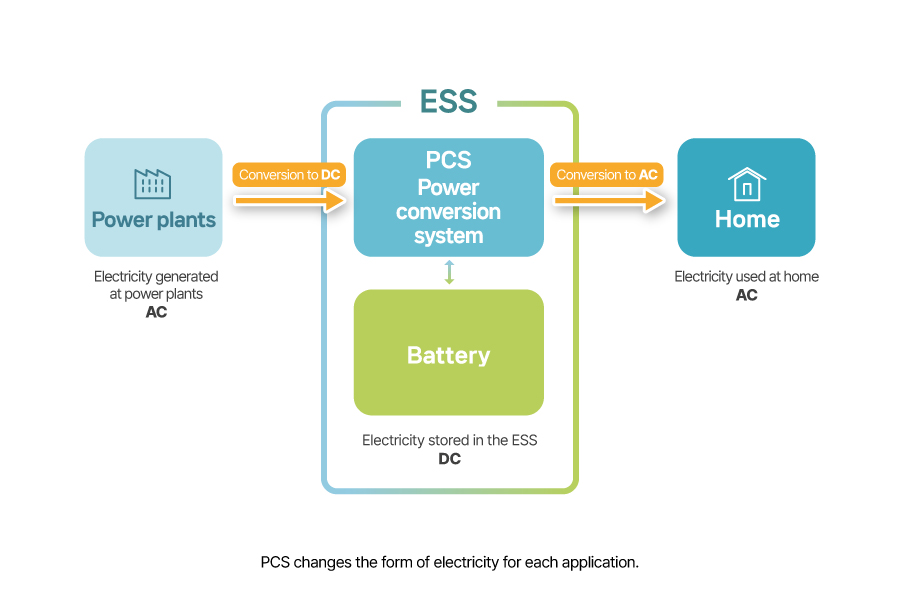
PCS (Power Conversion System) is a device that coverts power types within the ESS. Since the type of electricity differs when storing power in the ESS and when using stored power, the PCS plays a crucial role in converting power. Electricity generated at power plants and received at home is AC power when it is stored inside the ESS as DC power. The PCS also has a role in changing the form of electricity so that it flows safely and efficiently.
EMS (Energy Management System)

EMS (Energy Management System) is software that monitors and controls the overall status of an ESS, including power supply and consumption. It collects battery voltage and temperature data through BMS and uses this data to control both BMS and PCS. Moreover, EMS serves as the top-level operational system of an ESS that analyzes the whole metrics such as utilization rates.

SAMSUNG SDI Newsroom
We deliver the latest news and issues coming out of SAMSUNG SDI.