People & Culture
[SDI Today] SAMSUNG SDI Publishes Its 22nd Sustainability Report
2025.07.02
On June 27, SAMSUNG SDI released its ‘Sustainability Report 2025’ through the company’s official website.
SAMSUNG SDI was the first Korean company to publish a sustainability report in 2003. Since then, the company has transparently disclosed its ESG management activities and tangible outcomes. Starting this year, the report will be published exclusively in digital format to reduce paper usage and minimize environmental impact.
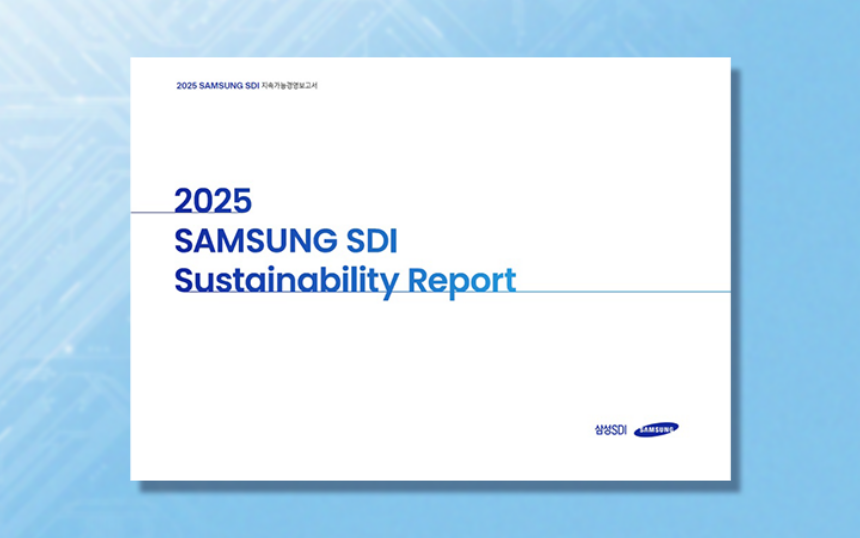
[SAMSUNG SDI's 'Sustainability Report 2025']
This year’s report outlines SAMSUNG SDI’s sustainability initiatives and achievements, with a particular focus on six material topics: R&D and Product Innovation, Climate Change Response, Energy Management, Waste Management and Circular Economy, Supply Chain Sustainability Management, and Occupational Health and Safety Management. These topics were selected based on SAMSUNG SDI’s annual materiality assessment and represent the core areas the company prioritizes in its ESG management efforts.
R&D and Product Innovation
In the battery industry, R&D and product innovation have become essential in response to the growing electric vehicle (EV) and energy storage system (ESS) markets. SAMSUNG SDI is also striving to proactively introduce new products and technologies, with a focus on enhancing battery safety, securing cost competitiveness and eco-friendly technologies. To this end, the company invested KRW 1,297.6 billion in R&D last year, bringing its total number of registered patents to 21,846.
Environment – Climate Change Response, Energy Management, Waste Management and Circular Economy
As part of its “2050 Net-Zero Roadmap,” SAMSUNG SDI reduced approximately 600,000 tons of GHG emissions last year and additionally obtained Carbon Trust* carbon footprint certification for two more products. In 2024, we introduced low-temperature regenerative dehumidifiers company-wide and installed steam flash recovery systems to reduce energy use. Additionally, SAMSUNG SDI is striving to increase the use of recycled minerals and minimize waste generated at our operations. Last year, we achieved a recycled metal usage rate of approximately 14% and obtained Zero Waste to Landfill Platinum certification* for all our domestic and overseas production sites.
*Carbon Trust: an organization established by the UK government in 2001 that provides carbon footprint certifications by measuring GHG emissions produced during the entire process of a production based on international standards.
*Zero Waste to Landfill Platinum certification: recognized by UL Solutions, a global safety science organization, ZWTL (Zero Waste to Landfill) designations are categorized into three levels: Platinum (100%), Gold (95–99%), and Silver (90–94%).
Social – Supply Chain Sustainability Management, Occupational Health and Safety Management
SAMSUNG SDI systematically manages supply chain risks by conducting ESG due diligence on partners in accordance with the OECD Due Diligence Guidance. As many as 70 partners underwent ESG audit last year, while 168 partners participated in capacity-building programs. In addition, each of Samsung SDI’s worksites has acquired ISO 45001 certification, ensuring thorough control of health and safety risks, including those affecting partner companies. Under this management system, we achieved a 100% grievance resolution rate for partners related to occupational health and safety last year.
SAMSUNG SDI is advancing toward a sustainable future through innovative technology and responsible management.

SAMSUNG SDI Newsroom
We deliver the latest news and issues coming out of SAMSUNG SDI.