Technology & Products
[Battery Glossary] Cell/Module/Pack, Rack/System, ESS
2025.06.13
|
[Battery Glossary] answers the questions related to batteries with key term explanation. From fundamental battery principles, manufacturing processes to emerging next-generation technologies, [Battery Glossary] makes battery concepts easy to understand. |
Cell/Module/Pack
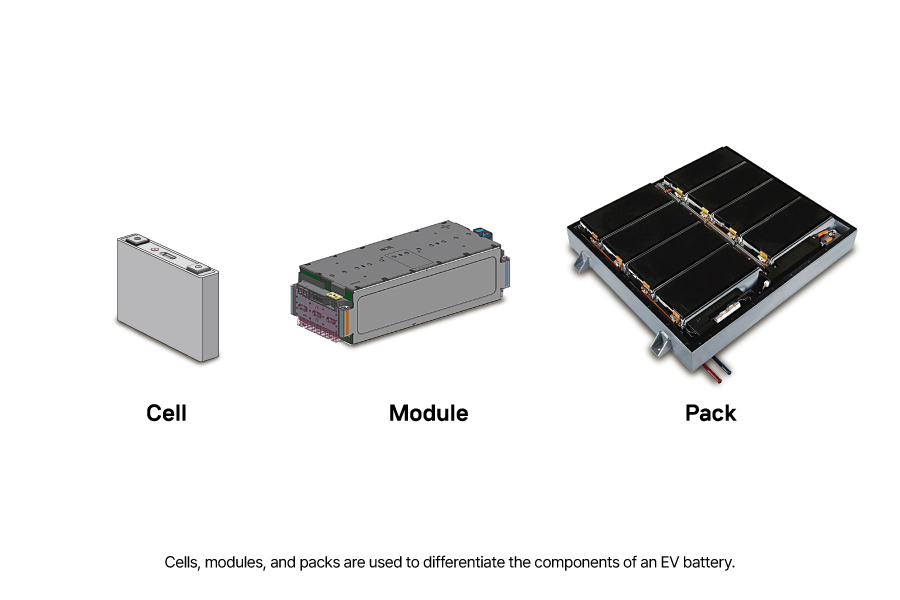
Cells, modules and packs are the units that make up a battery. These terms are commonly used to differentiate the components of a battery, particularly for EVs. A cell is the basic unit of a battery, referring to a single battery component. It is often simply called a battery. A group of cells is a module, which provides the frame that protects the cells from external shocks, heat and vibrations. The number of cells within a module varies depending on the capacity required by the customer. A pack is a group of multiple modules connected together with a Battery Management System (BMS), a cooling system and various control/protection components. Packs are the final form of a battery that is installed in EVs.
Rack/System
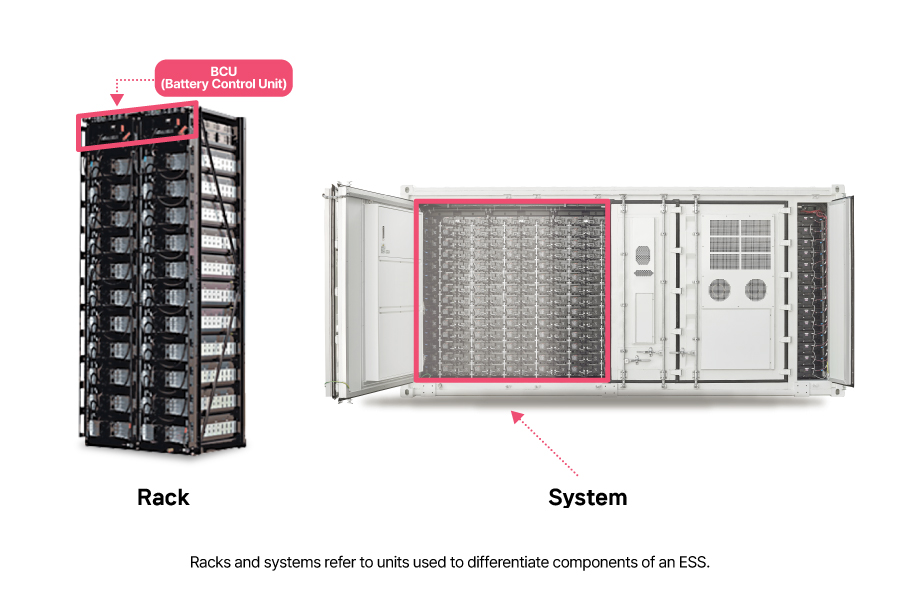
Racks and systems refer to units that group batteries, commonly used for Energy Storage System (ESS). A Rack is a structure where a certain number of battery modules are stacked in series inside a metal frame. It includes Battery Control Unit (BCU), which monitors parameters such as temperature and voltage to ensure stable operation.
The safety system within the rack includes fuses and DC contactors. Fuses prevent overcurrent when excessive current flows due to a short circuit. DC contactors control charging and discharging based on protection conditions, ensuring proper cell management. These multiple racks are connected in parallel to form a system.
ESS (Energy Storage System)
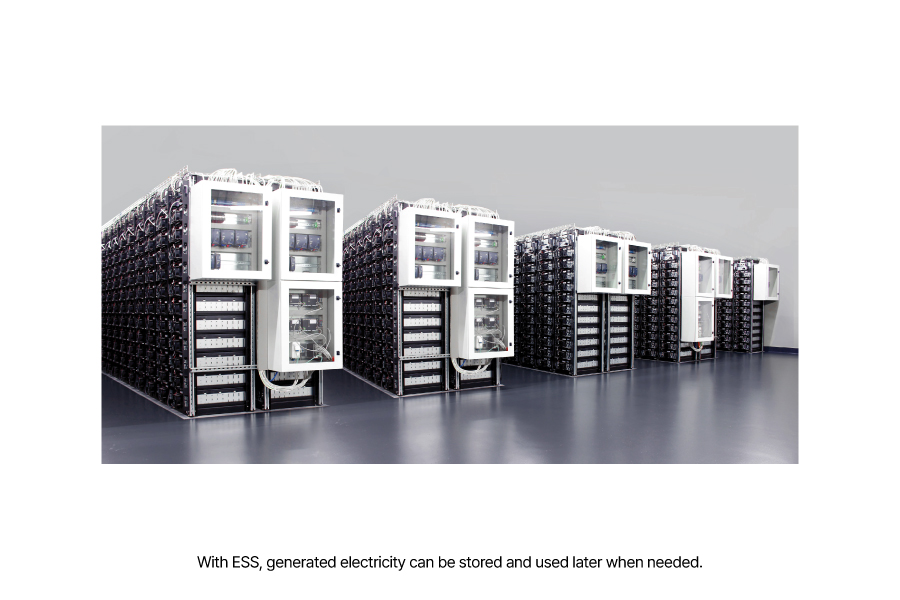
ESS (Energy Storage System) is a system that stores electricity and allows it to be used when needed. It is composed of a battery, BMS (Battery Management System), PCS (Power Conversion System) and EMS (Energy Management System).
There are four major applications of ESS: ①utility-scale, ②commercial, ③uninterruptible power supply (UPS) and ④residential. ①Utility-scale ESS is used to improve the quality of power generated at power plants and enhance the stability of an unstable power gird. ②Commercial ESS reduces electricity costs by optimizing power usage based on time-of-use rates. ③UPS provides short-term power supply in case of sudden blackouts. ④Residential ESS is often integrated with solar power systems, to minimize household electricity purchases.

SAMSUNG SDI Newsroom
We deliever the lastest news and issues coming out of SAMSUNG SDI.