Technology & Products
[1-Minute Battery] Why Can’t We Use Seawater as LIB Electrolyte?
2025.04.02
|
[1-Minute Battery] provides easy and quick explanations from simple curiosities about batteries to insightful questions! |
Electrolytes serve as a medium for transporting lithium-ions in lithium-ion batteries (LIB), and high ionic conductivity is one of the key requirements for an effective electrolyte.
But, interestingly, seawater, which covers about 70% of the Earth’s surface, has an ionic conductivity of approximately 5×10⁻²S/cm, significantly higher than the liquid electrolyte typically used in LIB (~1×10⁻²S/cm). So why can’t we use seawater as an electrolyte in LIB?
The answer lies in electrochemical stability. Electrolytes are in contact not only with the cathode and anode but also with various metals and components inside the battery. Electrochemical stability refers to the resistance to oxidation and reduction reactions, which is crucial for battery performance.
Electrolytes must allow lithium ions to move between the anode and cathode while ensuring that electrons only flow through the external circuit. This means that the electrolyte should not gain electrons from the anode where oxidation reaction occurs or lose electrons to the cathode where reduction reaction occurs. Therefore, the electrolyte must have a wide potential window.
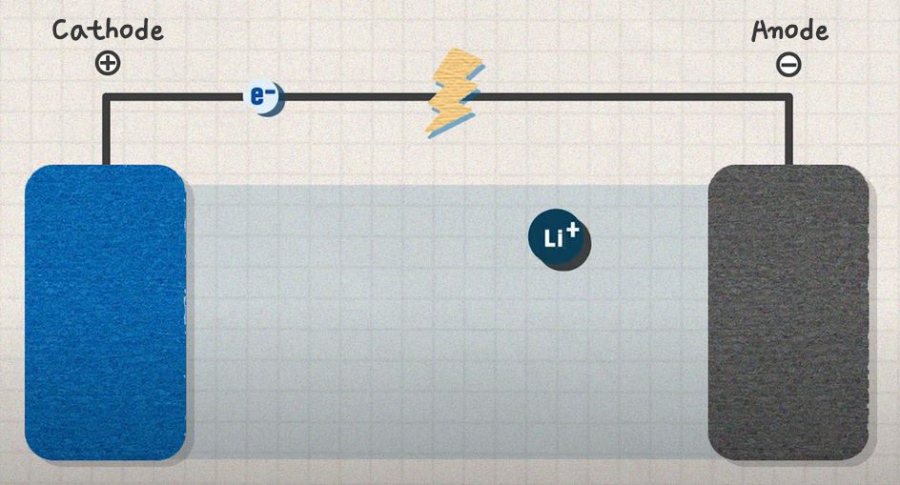
[Electrolytes of Li-ion Batteries should not gain or lose electrons while ensuring that electrons only flow through the external circuit.]
Potential window is a voltage range in which it remains still without undergoing oxidation or reduction. For LIB, the operating voltage exceeds 4V, whereas seawater has a narrower potential window. When voltage is applied, seawater decomposes into sodium hydroxide (NaOH), chlorine (CI2), and hydrogen (H2). This decomposition makes seawater unsuitable as an electrolyte despite its high ionic conductivity.
* Lead-acid batteries and nickel-cadmium batteries, which operate at lower average voltages, can use aqueous electrolytes.
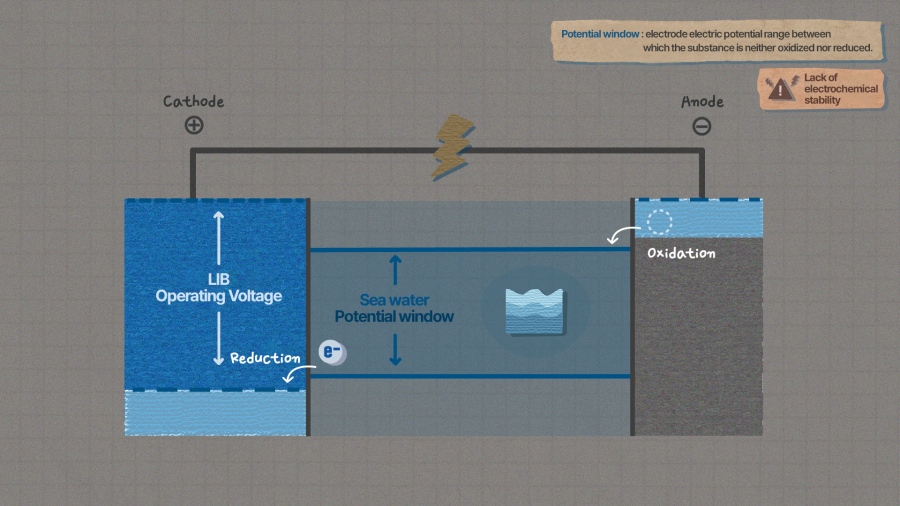
[Potential window should be wider than LIB’s operating voltage not to undergo oxidation and reduction]
Additionally, seawater is not stable within the typical operating temperature range of electronic devices (-20℃~60℃). Furthermore, lithium reacts violently with moisture, making seawater incompatible with LIB electrolytes.
For LIB, organic solvents with dissolved lithium salts (at a concentration of 1M) are typically used as electrolytes because they do not decompose. Lithium salts help facilitate the smooth movement of lithium ions.
Electrolytes for LIB can exist in various forms, including liquid, solid and gel, but all must have high ionic conductivity, wide operating temperature range and thermal and electrochemical stability.

SAMSUNG SDI Newsroom
We deliver the latest news and issues coming out of SAMSUNG SDI.