Press Releases
SAMSUNG SDI Declares Environment-Friendly Management
2022.10.04
|
Joins RE100, makes efforts to cut greenhouse gas emissions to tackle climate change Maximizes efforts to extend resource circularity to lead the eco-friendly ecosystem CEO YOONHO CHOI emphasizes “Environment-friendly management is a necessary corporate social responsibility for future generations and key competitiveness of business” |
SEOUL, Korea – October 4, 2022 – SAMSUNG SDI has declared environment-friendly management in a bid to join global efforts to overcome the climate crisis with awareness of the current crisis’ severity as a global eco-friendly energy and materials business.
SAMSUNG SDI today announced a package of environmental management strategies, including eight specific tasks under two themes - response to climate change and resource circularity - with an aim to reach net zero carbon emissions by 2050.
Since inauguration of President and CEO YOONHO CHOI early this year, the company has set its vision for becoming a Global Top Tier Company by 2030, and announced ESG management as one of key strategies along with ‘super-gap technology competitiveness,’ ‘best quality,’ and ‘profitable growth’ to realize the vision.
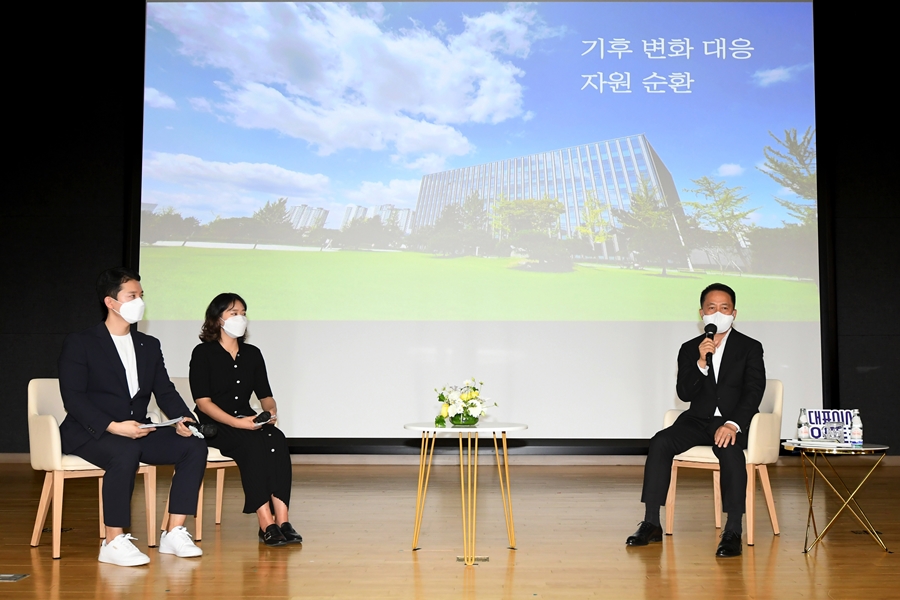
① Efforts in response to climate change
□ Use renewable energy for all operations… Joins RE100
SAMSUNG SDI has decided to use renewable energy across all of its workplaces by 2050. The company’s operations in Hungary, China (Tianjin) and Malaysia will take the lead in increasing the proportion of renewable energy use.
The measures to expand renewable energy usage include purchasing renewable energy certificates, introducing Green Premium, signing power purchase agreements and installing photovoltaic power generation systems within workplaces.
Among others, SAMSUNG SDI recently joined RE100.
RE100 is a voluntary initiative to replenish 100% of corporate electricity consumption with renewable energy, such as wind and solar power, by 2050. Multicultural non-profit organizations The Climate Group and Carbon Disclosure Project oversee the initiative. Companies with annual electricity demand of at least 100GWh are eligible for the initiative.
* The Climate Group: Multicultural non-profit organization d in London
* CDP(Carbon Disclosure Project): Non-profit organization that uates corporate responses to disclosure of information on greenhouse gas emissions and other energy issues
□ Reduce greenhouse gas emissions
For SAMSUNG SDI, a major source of its direct carbon emissions is the liquefied natural gas (LNG) that is used for boiler and incineration facilities – for dry rooms during the battery manufacturing process and prevention of air pollution, respectively.
SAMSUNG SDI plans to replace LNG-powered boilers with electric boilers and reduce the amount of dehumidifier steam used in dry rooms in order to cut emissions. Incineration facilities will be replaced with LNG-free absorption equipment.
The company also aims to lower the level of LNG consumption per 100 million won sales by recovering or recycling waste heat produced from manufacturing processes by 2050.
□ Expand introduction of Product Carbon Footprint (PCF)
The European Union is expected to legislate a regulatory work on batteries to reach its goals of net zero carbon emissions and sustainable batteries. If the regulation comes into effect, EU nations would mandate disclosure of carbon footprint of battery products and product ratings by emissions. This would ultimately regulate emissions.
In response to the expected policies, SAMSUNG SDI plans to enhance internal capabilities to calculate product carbon footprint and reduce the total carbon emissions from the entire process of battery manufacturing from preparation to disposal in order to expand products with PCF labels.
* Carbon footprint: The total amount of carbon emissions generated from the entire lifecycle of a product from manufacturing, distribution, consumption to disposal
□ Replace all corporate vehicles with zero-emission vehicles
SAMSUNG SDI has decided to replace all of its corporate vehicles, including leased ones, with electric vehicles, and continue to expand charging infrastructure.
In 2019, the company adopted electric buses as commuter buses for its Giheung headquarters. It also established EV charging infrastructure at all domestic workplaces.
Last year, SAMSUNG SDI joined K-EV 100, a project run by the Ministry of Environment to supply non-polluting vehicles.
* K-EV 100: A project by the Korean Ministry of Environment to have private companies switch to non-polluting vehicles by 2030
② Maximize resource circularity for eco-friendly ecosystem
□ Increase recovery of resources through battery recycling
Considering that the amount of used batteries would increase in line with a growing number of electric vehicles on the roads, SAMSUNG SDI plans to focus efforts on minimizing the impact of waste batteries on the environment throughout the entire product lifecycle.
The company will continue to expand using recovered raw materials such as cobalt, nickel and lithium from disposed batteries through recycling.
In cooperation with its recycling partners in Korea, SAMSUNG SDI currently extracts cobalt, nickel and lithium from scrap at its plants in Cheonan and Ulsan, and reuses them for battery manufacturing under a closed-loop system.
* Closed-loop: Scrap generated from manufacturing → recycling partners extract raw materials from scrap → precursors and cathode materials partners use the extracted materials → SAMSUNG SDI uses recycled materials for battery manufacturing
This year, the company has implemented the closed-loop system at its Malaysia and Hungary plants this year, and plans to expand it to China and the United States by 2025.
In addition, SAMSUNG SDI is already using professionally recycled battery materials from disposed batteries from electric vehicles, power tools and various IT devices, and will increase the proportion of those materials.
In May, the company launched Recycle Lab within its R&D organization to develop technologies to raise the recovery rate and to find new ways of retrieving eco-friendly materials.
SAMSUNG SDI also plans to develop new recycling technologies through collaboration with partners and academia.
□ Minimize waste-to-landfill at workplaces
At manufacturing sites, disposed organic solvents, waste oil as well as general waste are generated altogether.
The company used to bury or burn off such waste in the past, but is considering plans to minimize the amount of waste generated at the workplaces.
It will separately discharge general waste, while sending specific industrial waste to recycling companies for reuse.
SAMSUNG SDI has received a platinum level from global safety certification organization Underwriters Laboratories (UL) in recognition of exceeding 99.5% in waste recycling at its Giheung and Cheongju sites, and plans to have all sites receive the level by 2025.
□ Water conservation commitment
SAMSUNG SDI has set an aim to reduce the aggregate amount of water used for all operations through sustainable management of water resources by 2050.
To minimize the impact on the environment, the company will improve supplies of water via cooling pumps and reuse consumed water from the battery manufacturing lines or rainwater.
□ Minimize use of disposable products
In order to fulfill social corporate responsibilities and join the efforts to reuse resources, SAMSUNG SDI is striving to minimize the use of disposable and plastic products at all workplaces.
The company launched a campaign to refrain from using disposable products, and has a plan to reduce the amount of disposable and plastic products at all company stores by 2023.
□ CEO YOONHO CHOI says “Environment-friendly management is a necessary corporate social responsibility and key competitiveness of business”
SAMSUNG SDI in January launched Environmental Management Task Force headed by Chief Financial Officer Kim Jong-sung to implement environment-friendly management strategies.
After the launch, a committee on sustainability management was d under the company’s Board of Directors. In February, ESG Strategy Group under the Planning Team was expanded to Corporate Sustainability Governance Office under the CFO.
In addition, CEO Choi regularly checks on the progress of the company’s shift towards environment-friendly management by holding consultative meetings every quarter.
SAMSUNG SDI will make all of its environmental management activities transparent to its shareholders and stakeholders through continuous communication.
“Environment-friendly management is a necessary corporate social responsibility for future generations and key competitiveness of our business to become a Global Top Tier Company by 2030,” said President and CEO YOONHO CHOI.
Meanwhile, SAMSUNG SDI has been publishing annual reports on sustainability as the first in the battery industry since 2003, which provide its stakeholders with information regarding ESG activities in a transparent manner.
As a result, SAMSUNG SDI maintained its position on the Dow Jones Sustainability World Index for 17 times until last year, holding the record of being included in the list the most among Korean companies.
* DJSI World Index: Announced by S&P Dow Jones Index, the world’s largest financial information organization, it represents the top 10% of the world’s 2,500 largest companies in terms of ESG management

SAMSUNG SDI Newsroom
We deliver the latest news and issues coming out of SAMSUNG SDI.