Technology & Products
[ESG] SAMSUNG SDI’s Effort on Quality Management
2024.12.24
Guided by our motto ‘All for nothing without quality’, SAMSUNG SDI puts product safety and quality before all else: we continuously pursue robust quality throughout the entire product lifecycle. Our quality management system complies with global standards, and this is verified through the certification audits conducted across our global operations in accordance with ISO 9001* and IATF 16949*. We established The Quality Management 10 Commandments to lay the foundation for all our employees to develop their quality-first mindset.
* ISO9001: the international standard that specifies requirements for a quality management system that can be applied to all industries and activities. (Source: Korean Standards Association)
* IATF16949: the international standard developed by IATF for Automotive Quality Management Systems. It is adopted in all the automotive industry supply chain and quality systems (Source: GPC)
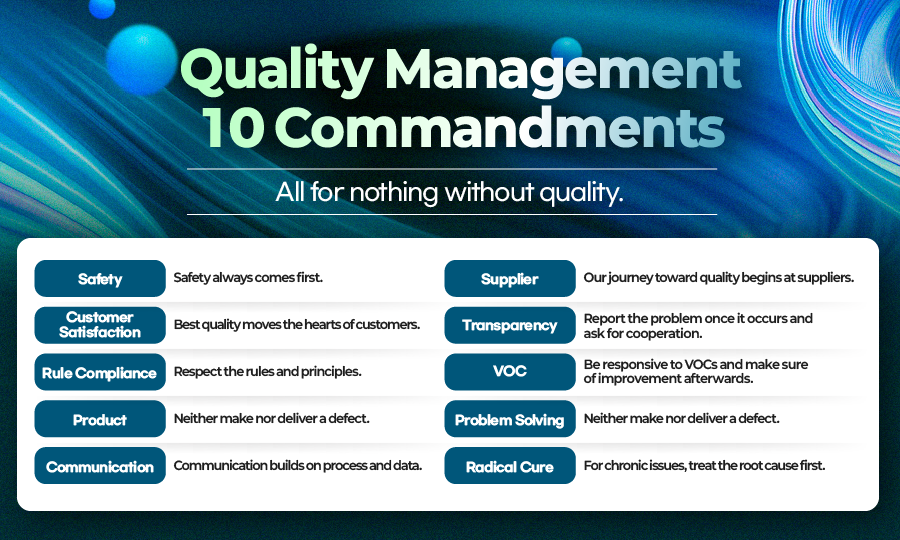
[The Quality Management 10 Commandments]
Bolstering Battery Safety
To keep pace with the market requirements for safety, SAMSUNG SDI developed thermal propagation prevention technology by connecting cells, modules, and battery packs, and is currently applying this to our products. We also perform a systematic battery safety test that includes compression, penetration and drop tests.
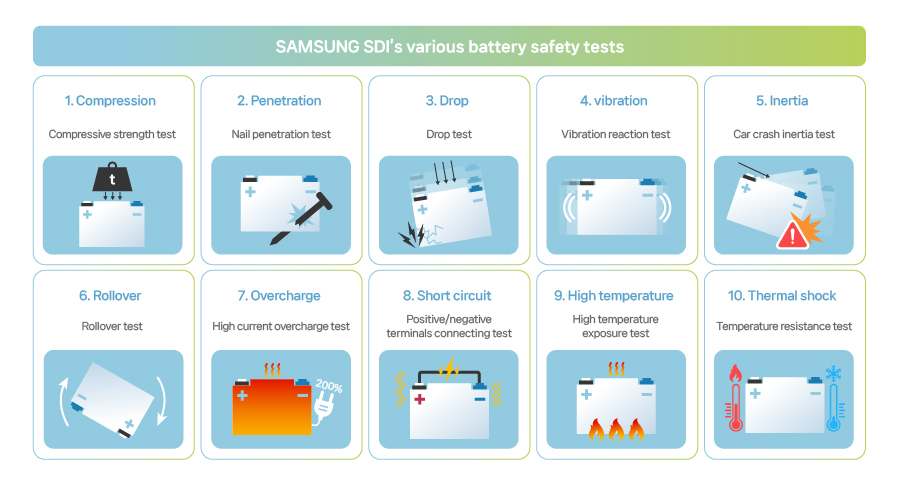
[SAMSUGN SDI’s various battery safety tests]
SAMSUNG SDI is developing Safety Battery (SB) models to improve the safety of our products. When excessive physical forces are applied from the outside such as 90º folding/unfolding, falling from extreme heights, or penetrating nails, ordinary batteries can get damaged. However, Our SB models adopted highly flexible electrode plates to prevent cracks while employing ceramic insulation layers and supplementary current collectors to prevent short circuits. Furthermore, safety additives were used to micro-control lithium dendrites*.
* dendrites: the growth of branch-like crystal structure on the surface of lithium metal cathode during battery charging and discharging process, which can undermine the performance and safety of a battery.
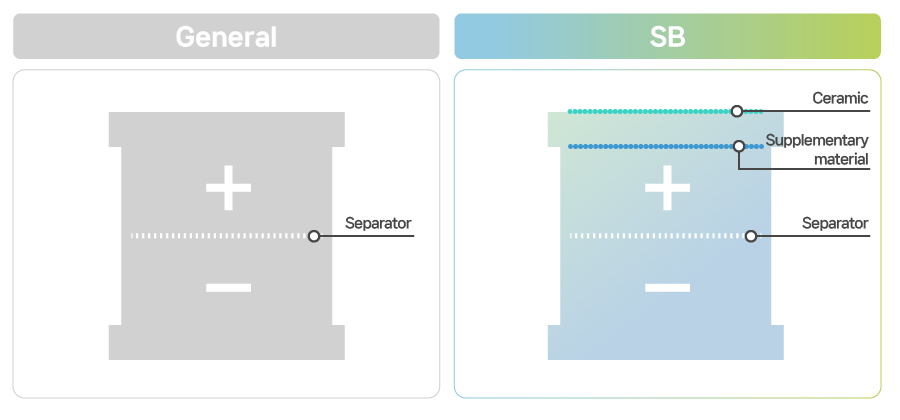
[SB Battery Overview]
Managing Customer Satisfaction
SAMSUNG SDI continues to improve CSI for EV battery customers by establishing the entire customer response process through customer consultation, such as addressing quality issues. As our 2023 strategic priority, we launched a project to achieve ‘100ppm* in defects for small-sized cylindrical EV products and the highest rating in EV customer assessment.’ We made improvements by establishing response process of ‘0km defects’ that prevents the car from moving after installing a battery. This improvement activity enabled us to reach 54ppm in ‘0Km defects’ against the set goal of 100ppm.
* CSI (Customer Satisfaction Index): a measure used to quantify the degree of satisfaction a customer has with a product or service.
* ppm (parts per million): a unit that represents 1 per every 1,000,000.
* 0km defects: a poor quality that prevents the car from moving after installing car parts. ‘0km defects’ in the article refers to poor quality that occurs before a car is sold to the end customer.
Extending the Scope of Quality Improvement Management
We continue with rigorous ‘Q-Gate (Quality Gate)’ implementation to ensure quality competitiveness at our production facilities in Korea and abroad. To strengthen the review process operation for the new and expanded lines of domestic and overseas corporations, we launched efforts to compile historical failures as white papers and review equipment quality risk. Moreover, with the help of rigorous global QC (Quality Control) monitoring, 18 testing methods were systematized in addition to beading* test, along with digitizing and automating testing items to reduce human errors.
* beading: the shape formed at the joint when welding
SAMSUNG SDI is also committed to helping partners improve quality. Through win-win innovation activities to achieve mutual growth with partners, innovation support teams organized by business division work on-site to help partners improve quality and competitiveness. In 2023, we had win-win innovation activities with 12 partners, and in 2024, we conducted win-win innovation activities with 15 partners, 7 in the first half and 8 in the second half. Our quality system audits were conducted on more overseas partners, from 67 companies in 2022 to 68 companies in Korea and 45 companies overseas in 2023.

SAMSUNG SDI Newsroom
We deliver the latest news and issues coming out of SAMSUNG SDI.