Technology & Products
[Battery101] How Do BEV, HEV, and PHEV Differ?
2024.08.23
|
101[wʌ́nouwʌ́n] means basic knowledge of a topic or collection of introductory materials to a topic. Our Battery 101 series talks about all things battery: the history, technical aspects (basic principles and mechanisms), industrial aspects (IT, electric vehicles, ESS, etc.), and next-generation technologies that SAMSUNG SDI will innovate while opening up its future. Batteries have infinite potentials that exceeds our wildest imagination. Through Batteries 101 series, you will have a chance to see the entire spectrum of the battery's possibilities and to conjure SAMSUNG SDI’s pivotal role in it. |
Fun picking out your choice of EV
Recently, public interest in electrified cars is rising largely because of an increasing level of the green mindset as well as low maintaince cost. Major countries have been designing EV policies to encourage customers, and many global finished car makers have been putting forward various types of EV line-up.
The fundamental difference that distinguishes ICEs from EVs is their energy source. Conventional cars convert thermal energy into kinetic energy by using fossil fuels like gasoline or diesel. That is a contrast to EVs using electric energy. In other words, ICEs convert thermal energy into kinetic energy, and EVs convert electric energy into kinetic energy through a motor.
Engines go through a four-stroke cycle of intake, compression, combustion and exhaust enhabled by mechanical components interlocking with each other and convert thermal energy into kinetic energy. This is how coverted kinetic energy powers a car. Electric vehicles, however, operate on electricity to spin a motor, which then transfers power to drive the wheels. When an electric current flows through the coil, the motor directly utilizes kinetic energy generated by the magnetic field and the magnets within the motor. Unlike the 4-stroke cycle of ICE engines, electric vehicles can run on 2-stroke or even 1-stroke cycles, making them quieter and more responsive.
The proportion of engine and motor use defines electric vehicles. Specifically, they include battery electric vehicles (BEV), hybrid electric vehicles (HEV), plug-in hybrid electric Vehicles (PHEV) and electric vehicles (EV). EVs run entirely on electric energy. Hybrid electric vehicles (HEV) and plug-in hybrid electric vehicles (PHEV) uses a combination of an internal combustion engine and an electric motor. The proportion of the electric motor use increases in the order of HEVs, PHEVs and EVs.
Such difference comes from differing primary and auxiliary power sources: HEVs use fossil fuel as a primary power source and electricity as a auxiliary power source, while PHEVs use electricity as a primary power source and fossil fuel as a auxiliary power source. Let’s take a look at the characteristics, as well as pros and cons for each EV.
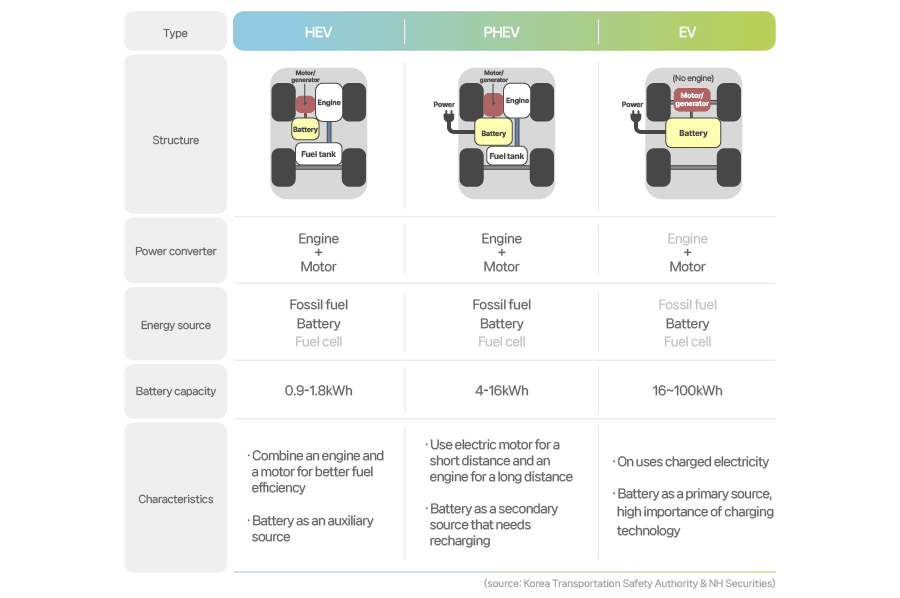
[Types of electric vehicles]
Hybrid Electric Vehicles (HEV)
"Hybrid" refers to “a mixture” by definition, which means combining two functions or roles into one. HEVs add an electric motor and a low-capacity battery to a conventional ICE vehicle. The electric motor of HEVs is used for small power demands, such as starting and low-speed driving, while both the engine and the motor are used for high power needs or high-speed driving. The motor's output and battery capacity are smaller compared to BEVs, and charging occurs through a generator when the engine is running.
HEVs are more fuel-efficient and produce fewer pollutants compared to ICEs because the motor is consistently taking part in powering the car. And because the battery is charging while driving there is no need for HEVs to be plugged in for additional charging. However, HEVs have more complexted structure and are more expensive than conventional vehicles, and they exhaust gases while the engine is running. Because the battery of HEVs provide electricity to the motor that is used as an auxiliary power source, HEVs require high output and durability despite having small capacity.
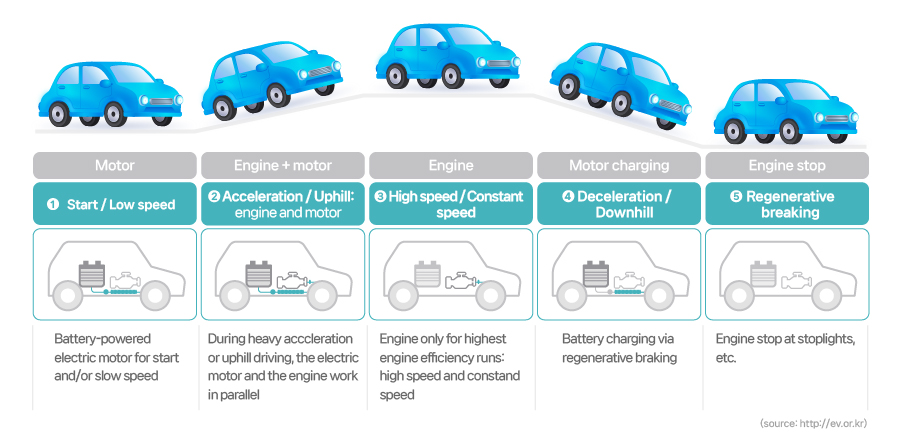
[The workings of HEVs]
Plug-in Hybrid Electric Vehicles (PHEV)
PHEVs are the opposite of HEVs; PHEVs use electric energy as a primary power source and the engine as a backup. For standard driving they run on electric power, and for high-speed or long-distance travel, the engine is working. The main difference from HEVs is that PHEVs can be charged by being plugged into an external outlet. When the battery is depleted, the vehicle switches to using the ICE or hybrid mode. For example, PHEVs use the electric motor when driving at low-speed in the city and the ICE when driving in regions where there are no charging stations. PHEVs emit fewer emissions compared to HEVs. The battery of PHEVs should have high energy density with large-capacity as it is used as the primary energy source.
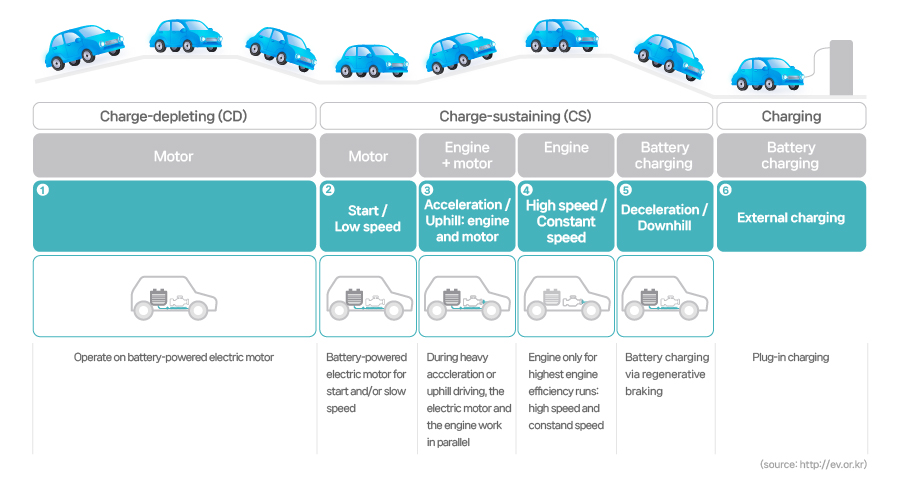
[The workings of PHEVs]
Battery Electric Vehicle (EV)
EVs operate solely with an electric motor, without an engine, which eliminates noise and vibration. The absence of sound and vibration, created during the conversion of fossil fuels into thermal energy, significantly improves ride comfort. EVs don’t exhaust emissions. Because they don’t require an engine, fewer number of componets are in the vehicle, which makes it a simpler structure. EVs require high-density, large-capacity batteries. Fast-charging is considered essential because longer charging time reduces user conveninence.
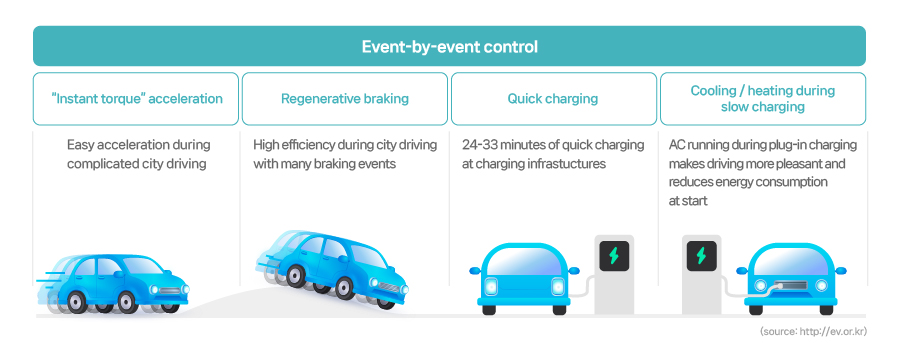
[The workings of EVs]

SAMSUNG SDI Newsroom
We deliver the latest news and issues coming out of SAMSUNG SDI.