Technology & Products
[Battery101] Ask Anything About EVs
2024.09.13
|
101[wʌ́nouwʌ́n] means basic knowledge of a topic or collection of introductory materials to a topic. Our Battery 101 series talks about all things battery: the history, technical aspects (basic principles and mechanisms), industrial aspects (IT, electric vehicles, ESS, etc.), and next-generation technologies that SAMSUNG SDI will innovate while opening up its future. Batteries have infinite potentials that exceeds our wildest imagination. Through Batteries 101 series, you will have a chance to see the entire spectrum of the battery's possibilities and to conjure SAMSUNG SDI’s pivotal role in it. |
EV growth on governmental support
The growth of the EV market was backed by the government policies around the world. Around the mid-2010s, when governments began to announce policy support for zero-emission car adoption, significant financial support in the form of subsidies and tax incentives were introduced. Now, some of these policies have been scrapped and new ones are emerging.
The EV policy can be divided into Pull or Push policy: providing consumers with purchase incentives to boost demand for EVs (Pull), and requiring automakers to expand the supply of the EVs (Push). In other words, Push policy is to encourage EV purchases, and Pull policy is CO2 fuel economy regulations that increase the EV production and supply.
Pull policies began to take off around 2017. Consumer’s experience of purchasing EVs with government subsidies went viral. Governments around the world provided EV subsidies accounting for 15 to 49 percent of the price of EVs in the past. Useful policies have been implemented, from providing a subsidy to encourage the replacement of old cars with EVs to giving tax incentives including purchase, registration, and car tax. Even today, countries have different policies to promote EVs. A recent example is the Inflation Reduction Act (IRA) in the United States.
Push policies are the step to drive transition to EVs by implementing CO2 emissions and fuel economy regulations. Since 2021, Europe has implemented regulations that impose a €95 fine on all new vehicles for every gram of CO2 emissions above an average annual target of 95 grams per kilometer, and the regulations are getting stricter. South Korea, too, strengthened its regulations since 2020. China, who has the largest EV market, also forced automakers to produce EVs in proportion to their overall production.
Such policies are driving the growth of the EV market.
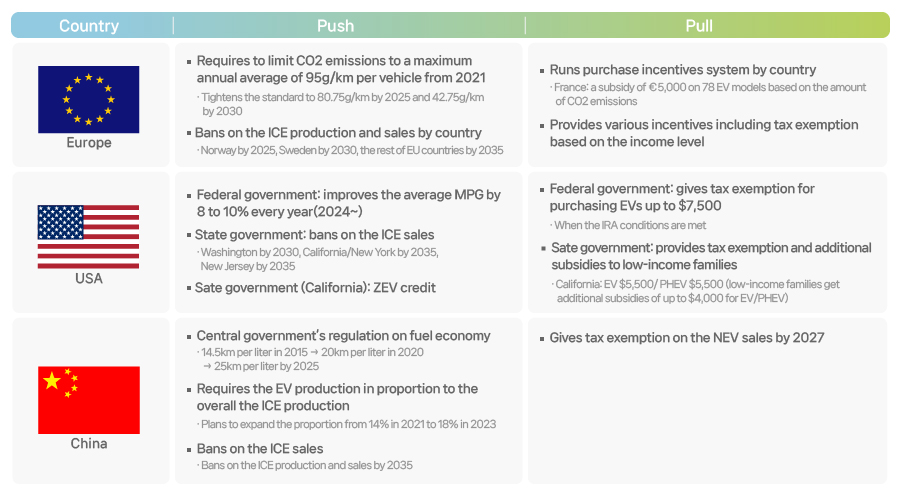
[EV policies by country]
Greater leap behind the Chasm
The number of registered EVs is continuously growing thanks to the EV policy efforts of each countries. But, the growth of EVs itself has taken a slight downward trend followed by the recent Chasm phenomenon, which is originally from a geological term referring to a gap or a crack in the earth. Chasm, as an economic term, refers to a temporary slowdown in demand and a phenomenon where it takes time for consumers to adapt to and see value in products and services that introduce new technology. Take MP3 players, for example: They came on the market alongside new technologies, but were temporarily pushed out by CD players, only to become a customer choice with the advent of the internet.
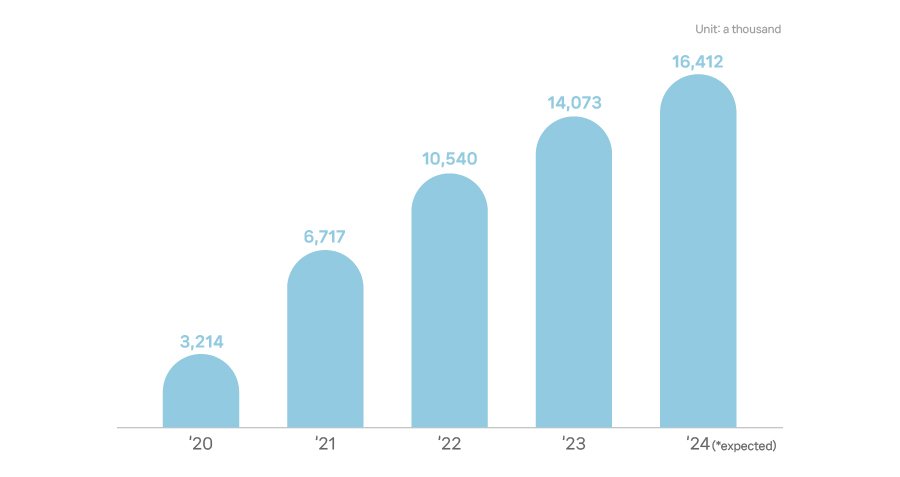
[Global EV sales]
The EV industry also experienced a slight slowdown in its growth due to the chasm, but is still on a growth trajectory for a greater leap. Along with improving infrastructures like building charging stations to quickly overcome the chasm, battery companies still have a few challenges: improving battery performance and securing competitive pricing SAMSUNG SDI will spare no efforts in order to secure ‘Super-gap’ technology competitive based on the best quality and safety going forward.

SAMSUNG SDI Newsroom
We deliver the latest news and issues coming out of SAMSUNG SDI.