Technology & Products
[Battery101] ESS Opens the Future
2024.10.04
|
101[wʌ́nouwʌ́n] means basic knowledge of a topic or collection of introductory materials to a topic. Our Battery 101 series talks about all things battery: the history, technical aspects (basic principles and mechanisms), industrial aspects (IT, electric vehicles, ESS, etc.), and next-generation technologies that SAMSUNG SDI will innovate while opening up its future. Batteries have infinite potentials that exceeds our wildest imagination. Through Batteries 101 series, you will have a chance to see the entire spectrum of the battery's possibilities and to conjure SAMSUNG SDI’s pivotal role in it. |
Leading green energy business
The humanity has long been advancing industries by using fossil fuel, but there is a growing interest on renewable energy, which can be replaced with fossil fuels as we experience severe environmental crises, such as CO2 and fine dust caused by fossil fuel.
Renewable energy sources, such as solar, wave, and wind is are highly dependent on weather conditions. There is a growing concern that as the share of renewable energy in the global power mix increases, the overall security will decrease. Energy Storage System (ESS) is seen as a breakthrough to address the problem of inconsistency in renewable energy.
If we build a power plant that incorporates renewable energy into the ESS, it will increase efficiency by reducing the load on power transmission, which will ultimately double efficiency. Some studies have shown that incorporating solar power into the ESS will increase generation revenue by 2 to 2.5 times compared to solar alone. In order to make a successful transition to a greener society, we are in serious need to expand the use of the ESS.
Each countries’ green energy policy is critical. In 2027, Korea announced a ‘Renewable Energy Action Plan 2030’ to increase the share of renewable energy sources, such as solar and wind, in the energy mix to 20 percent by 2030. Since 2012, energy companies have been required to include a certain percentage of their electricity from solar and wind power. This is referred to as a Renewable Portfolio Standard (RPS). Here, the key is the Renewable Energy Certificate (REC).
Solar or wind power generators can receive RECs for the amount of electricity they generate and can trade them for cash. Large generators have to buy RECs to meet their obligations if they fail to include a certain percentage of solar and wind power of their total electricity production. As the market continues to trade RECs, profit is produced. The government also mandates a certain percentage of the ESS installed in large public buildings that use more than 1 megawatt of electricity. This is a kind of state-led ESS expansion policy. Furthurmore, The government has announced a plan to expand ESS to stabilize the power grid as part of its ‘strategy to promote distributed energy’.
Green policies are also actively practiced abroad. Europe has announced a legislative package (FF55) to reduce greenhouse gas emissions by 55% by 2030 and achieve carbon neutrality by 2050. The U.S. has also enacted laws requiring the installation of ESS in states such as California, Oregon, and Massachusetts. Each state has its own independent support programs and plans to expand renewable energy through RPS and tax incentives.
So far, green energy policies seems to be on track. If such policies are well implemented, renewable energy generation in major European countries is expected to increase from 30% in 2021 to 50 to 75% in 2030. At the same time, the market for ESS is growing.
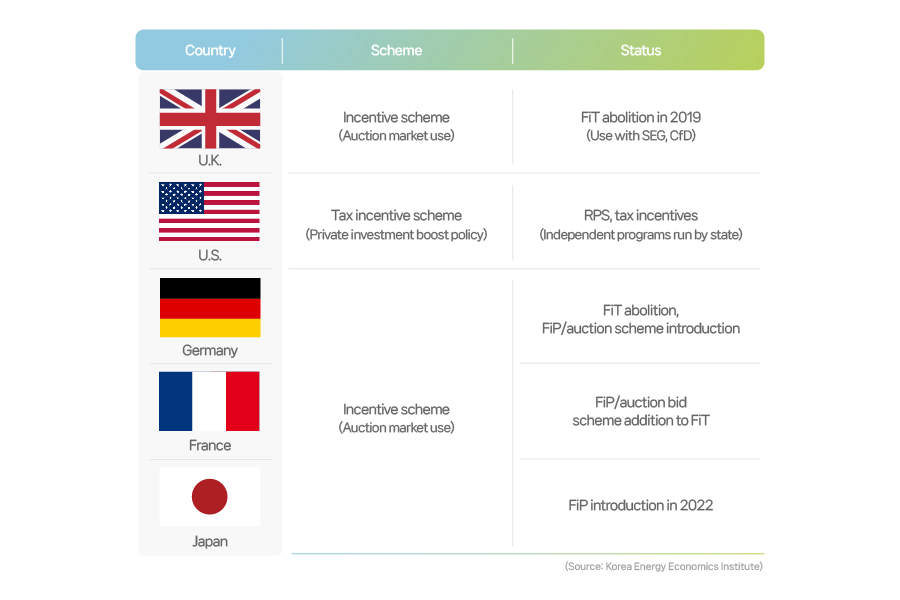
[Renewable energy schemes and status by country]
ESS opens the future
In the past, there were mainly two renewable energy issues. Since the 1970s, with the oil crisis and nuclear power plant accidents have led to discussions about diversifying energy supply, and after the 2000s, the need for renewable energy has emerged in terms of responding to climate change. And in 2015, the 2015 Paris Agreement paved the way for the rapid growth of ESS business.
The main driver is affordability. Major issues are as follows: RE100, a campaign to ensure that 100% of the electricity used by companies is renewable energy, ESG management, which promotes sustainable development through environmental, social responsibility, and transparent management, and carbon border taxes, which impose tariffs on products produced and imported from countries that emit more CO2 than importing countries. Thus, economic imperatives for countries and companies to expand renewable energy are gaining momentum. On top of that, if we develop batteries that have high energy density and reduce costs, ESS is only going to grow along with renewable energy.
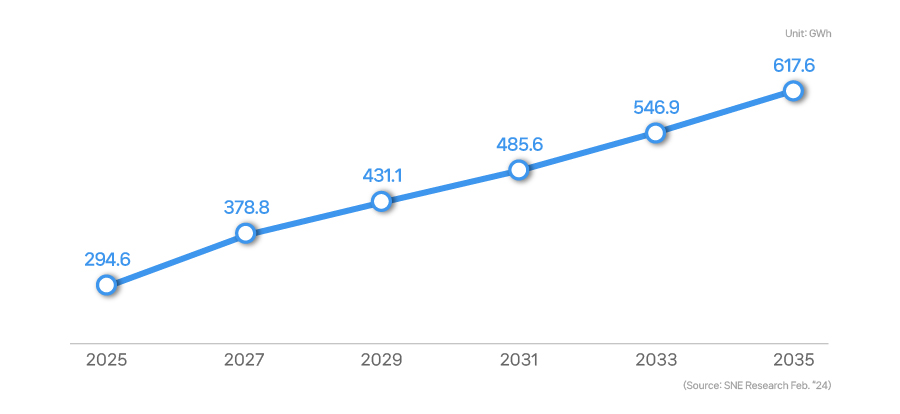
[Global ESS Battery Market Forcast]
SAMSUNG SDI officially began ESS business in 2010. In 2011, SAMSUNG SDI signed an exclusive contract with Nichicon in Japan and became the No.1 in Japanese residential ESS market share. Later in 2016, SAMSUNG SDI Later in 2016, SAMSUNG SDI gained global notoriety for its successful execution of the Aliso Project in California, which was the largest ESS project in the world at the time. We have successfully carried out projects with many companies so far. SAMSUNG SDI plans to continue to lead the ESS industry based on our differentiated competitiveness as a global battery leader.

SAMSUNG SDI Newsroom
We deliver the latest news and issues coming out of SAMSUNG SDI.